
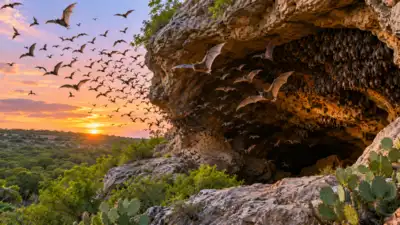
Image AI generated
Phillip Eckert bought the ranch on which the cave stands in 1907. When Lee died in 1967, he left the site to his wife and children. In 1990, Richard Phillip Eckert and Virginia Eckert Garrett donated the cave to TNC. The donation came with one condition: the land around the cave must remain open to the public for enjoyment and education, as it had been for more than 100 years.
Because free-tailed bats have a low birth rate, TNC states that a single act of vandalism can destroy a colony. Because of the disturbance and destruction of roost sites by humans, the brochure says the population has declined dramatically in some areas of the country, largely.
The brochure says the bats use the cave to give birth and raise their pups before returning to Mexico. TNC’s page says the cave’s history is closely tied to the Eckert family. The preserve page says the gift honoured their father and grandfather, and that it ensured the bats would be permanently protected. TNC says it is happy to continue that tradition. It developed a cooperative management plan with Bat Conservation International, according to TNC. The brochure says the preserve is an important research site that helps to inform bat conservation strategies across Texas.
It also states that the preserve is home to one of the largest aggregations of warm-blooded animals in the world. W. In the early 1900s, he mined the bat guano in the cave and sold it to local farmers as crop fertiliser. His son, Lee Eckert, continued the guano mining and his father’s legacy of bat conservation. The brochure gives the same account of the family’s history and the donation. TNC’s page explains that, like all bat species, the Mexican free-tailed bats play a part in the region’s ecology. Each night they search thousands of acres of countryside for food. Each bat eats close to its body weight in mosquitoes and other insects, including crop pests such as cutworm and corn borer moths. The brochure adds that some bat species act as agents of seed dispersal and cross-pollination. These benefits depend on roosting sites such as the Bat Cave remaining undisturbed. Disturbance usually leads either to a roost being abandoned completely or to the decimation of the bat population. It adds that the bats give birth to only a single pup each year, so the population recovers slowly. The plan prevents people from entering the cave during maternal activity, controls visitation, monitors the bat population and protects the cave’s opening. Scientific research continues at the site, and the cave remains open to scientists for most of the year.
In 1990, Richard Phillip Eckert and Virginia Eckert Garrett donated a cave in Mason County, Texas, to The Nature Conservancy in honour of their father and grandfather. The family set one condition: the land around the cave must stay open to the public for enjoyment and education, as it had been for more than 100 years. It says the cave is about 500 yards from the parking area along a trail that is not wheelchair accessible. The brochure lists a fee of $5 per adult, with children aged five and under admitted free. TNC’s page states that the 2026 viewing season has ended and the preserve is closed until summer 2027.
About four million female Mexican free-tailed bats now use the Eckert James River Bat Cave Preserve each year from May to September, and many give birth to a single pup in June, according to the Conservancy. The cave is “one of the largest bat nurseries in the nation”, according to TNC’s preserve page. The page says about four million female bats inhabit the preserve from May through September. TNC says visitors can watch the bats flutter and chirp around the cave mouth an hour or two before sunset. The brochure describes the preserve as “a true wilderness area” with no electricity, restrooms, water or food, and it does not allow pets.
The gift ensured the bats would be permanently protected. Many of the females give birth to a single pup in June. The pups join their mothers in flight at about five weeks of age and stay with them until the colony returns to Mexico in October. The preserve’s brochure gives the same figures and names the species as the Mexican free-tailed bat. It describes the site as lying in the Texas Hill Country, southwest of the town of Mason. Each summer the preserve also serves as an educational site. The bats first fly in a large, low circle and then spiral upwards into a funnel that reaches several hundred feet into the sky. This lasts about an hour. You use AI every day. Now get your AI Quotient. Take the AIQ test.