
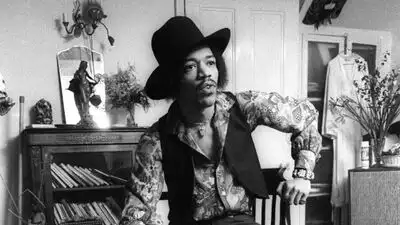
Jimi Hendrix. Image Credit: Heritage Fund
Located in Mayfair, the third-floor residence at 23 Brook Street was where Hendrix lived with his girlfriend Kathy Etchingham during the height of his musical career. The National Lottery Heritage Fund explains that Hendrix lived at 23 Brook Street between 1968 and 1969, when his career was flourishing. Etchingham discovered the flat through an advertisement in a London evening newspaper in June 1968 while Hendrix was in New York, according to Museums London. George Frideric Handel occupied 25 Brook Street from 1723 until his death in 1759, spending 36 years in the house. The project was supported by a £1.2 million grant from the Heritage Lottery Fund and carried out by the Handel House Trust. The Hendrix Museum opened to the public on 10 February 2016, allowing visitors to explore a space that had previously been associated primarily with the musician’s private life, according to the Heritage Fund. Handel Hendrix House explains that 25 Brook Street was where Handel lived, composed and rehearsed many of his works. The composer arrived in London in 1712 and eventually settled at Brook Street in 1723. He remained there until his death in 1759. Messiah was among the works associated with the house and was rehearsed there before its first performance in Dublin in 1742. Chronicle Trails reports that a £3 million project began in 2022, followed by a reopening in May 2023. Handel’s residence survived changes in use, including a conversion into a shop in 1905, while Hendrix’s flat eventually became part of the museum’s administrative space before its restoration.
The National Lottery Heritage Fund reported that the restoration returned the third-floor flat to its 1960s appearance.
The property was part of a newly developed section of Mayfair and became closely associated with Handel’s professional life, according to Chronicle Trails. Jimi Hendrix spent less than a year living in a small London flat, yet the property became one of the most personal places associated with the rock legend. He reportedly described it as the only home he ever had. the modest flat offered something different from the demands of touring and performing Although he was internationally recognised as a guitarist. It became a place where he could settle into everyday domestic life. He briefly moved in during July before leaving for an extensive tour of the United States. The couple later returned to the property, where they created a home that reflected their personal tastes. The flat was not simply a temporary place to stay. Hendrix decorated it himself, purchasing turquoise curtains and cushions from John Lewis, alongside ornaments and small decorative objects from Portobello Road Market. These details help explain why the residence became particularly meaningful to him. The connection between Hendrix and Handel was more than an unusual coincidence of addresses. As documented by Museums London, the composer created some of his most enduring works there, including Messiah. Handel’s former residence was separated from Hendrix’s flat by a wall, placing two musicians from vastly different eras in neighbouring properties. The National Lottery Heritage Fund notes that the connection sometimes caused confusion among visitors searching for Handel’s home, who would mistakenly knock on Hendrix’s door. The museum’s account also records that Hendrix eventually became aware of Handel’s connection to the neighbouring building. Rather than dismissing the coincidence, he developed an interest in the composer’s music and purchased recordings of Messiah and Belshazzar. The Hendrix flat eventually became an important part of London’s musical heritage. Its restoration was undertaken to recreate the atmosphere of the late 1960s, rather than turn the property into an ordinary exhibition space. Personal details, including replicas of the turquoise curtains Hendrix and Etchingham bought from John Lewis, helped recreate the domestic setting. His vinyl record collection also formed part of the experience, connecting visitors with his musical interests and everyday surroundings. The organisation’s work brought together the preservation of Handel’s historic home and the restoration of Hendrix’s comparatively modern flat. The first-floor front room served as a rehearsal room, while another room is believed to have been used for composing. The house also had a social purpose. Handel regularly rehearsed musicians and singers and held informal performances for friends and neighbours. The museum now brings both properties together as Handel Hendrix House. The official Handel Hendrix House website describes its mission as caring for and presenting the historic residences of Handel and Hendrix. The museum’s expansion also made more of Handel’s house accessible to visitors. You use AI every day. Now get your AI Quotient. Take the AIQ test.
Remarkably, the building stood beside the former residence of George Frideric Handel, a celebrated Baroque composer who had lived there more than two centuries earlier. the neighbouring house provides a much earlier chapter of London’s musical history While Hendrix’s flat captures the atmosphere of the 1960s. The institution adopted the name Handel Hendrix House, replacing its earlier name, Handel & Hendrix in London.
Museums London describes the restored dining room as a place where this musical activity took place, with concerts continuing there today. Today, the two adjoining properties stand as reminders of London’s ability to attract musicians from different backgrounds and centuries.