
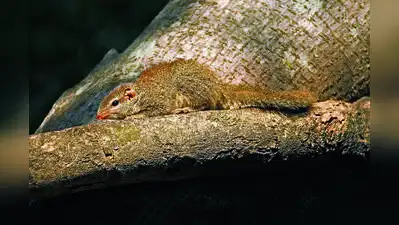
Madras treeshrew
“Sightings were also reported from places such as Uthangarai in Krishnagiri district, Kolli Hills in Namakkal district.
The species was always there, but few knew what they were looking at,” says Baskaran. “The species is adapted to our regional environment but has been neglected in conservation circles for decades,” he says. Hidden in the forests of the Kolli Hills, Shervarayan Hills (Yercaud) and pockets of the Eastern Ghats , and often mistaken for a squirrel is the Madras treeshrew (Anathana ellioti). One of India’s most evolutionarily distinct mammals, it is drawing concern from conservationists who warn that habitat degradation and a lack of scientific attention could threaten the future of the little-known species. The Madras treeshrew is the sole surviving member of the genus Anathana, making it a species of exceptional scientific importance. researchers say local populations face pressure from habitat fragmentation and encroachment Although International Union for Conservation of Nature (IUCN) lists the species as of ‘least concern’.
We need more field studies and documentation before we can formulate conservation strategies,” says a forest department official. Every observation, photograph and record, made without disturbing the animal, becomes a step towards saving the species,” says conservation biologist R Brawin Kumar. “Climate change is impacting its populations, and studying this species in detail is the need of the hour. ” Dharapuram-based environmentalist Theodore Baskaran says earlier scientific classifications placed treeshrews close to primates because of certain anatomical similarities.
“Unlike tigers, elephants and leopards, smaller mammals rarely get focused conservation attention. The Madras treeshrew is found in some of our hill ecosystems, but there is limited scientific data on its population and distribution. The species performs several important ecological functions. Feeding on insects, fruits and other small food sources, it helps regulate insect populations and contributes to seed dispersal. It also forms part of the prey base for larger predators. Researchers say the animal spends much of its time foraging among rocks, leaf litter and dense undergrowth on the forest floor, making it vulnerable to habitat disturbance. “The Madras treeshrew is a shy jewel of our forests, and I urge the Union and state govts to protect its habitat while encouraging citizen science. However, modern research has established that they occupy a separate taxonomic position.