
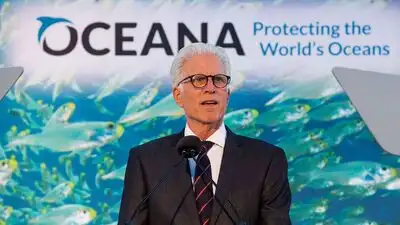
Image Credit: Tom Vickers/Impacting Our Future
He became interested in protecting the ocean in 1982 after moving to a California neighbourhood where residents were fighting to prevent oil drilling near their beach, according to the Cornell Chronicle. Danson’s 2009 written testimony before the US House Committee on Natural Resources explained that he had teamed up with an environmental expert to fight Occidental Petroleum’s proposed slant drilling off Santa Monica in the late 1980s. Oceana’s official Ted Danson profile says he helped establish the American Oceans Campaign in 1987, following the Santa Monica victory. Oceana was founded in 2001 as an international organisation focused exclusively on ocean conservation. The American Oceans Campaign subsequently merged with Oceana in 2002, expanding its capacity to work internationally. In his 2009 congressional testimony, he argued that oil and gas development threatened marine wildlife, coastal communities and the livelihoods connected to the sea. Global Heroes reported in its 25th anniversary coverage that Oceana had expanded its campaigns across 10 coastal countries and the European Union, protecting more than 4 million square miles of ocean and achieving over 350 policy victories.
The Cornell Chronicle reported that Danson hired a lobbyist and began advocating for ocean conservation in the US capital.
Danson said it had made around one-third of the world’s industrial fishing fleet trackable, helping governments identify illegal fishing and harmful practices. Danson continues to serve on Oceana’s Board of Directors alongside his wife, actress Mary Steenburgen, according to the organisation’s official profile. Ted Danson is widely recognised for his television roles in Cheers and The Good Place, but his work beyond Hollywood has helped shape an international movement for ocean protection. The actor’s environmental activism began in California during the 1980s, when a proposed offshore oil drilling project threatened the coastline near his home. What started as a neighbourhood campaign eventually led to the creation of the American Oceans Campaign and, later, his involvement with Oceana, an organisation working to protect marine life and restore the world’s oceans. His journey illustrates how celebrity influence can support long-term environmental action. Danson’s involvement in ocean conservation began with a problem close to home. The proposal involved offshore drilling near Santa Monica Bay, and Danson joined local residents in opposing it. Rather than limiting his involvement to expressing concern, he helped organise the community and worked to bring the issue to a citywide ballot. The campaign proved successful. The effort succeeded, preventing the project from proceeding. The experience demonstrated to Danson that organised public action could influence environmental decisions. It also gave him a reason to continue working beyond a single local campaign. The next step was to turn local activism into a more organised effort. The organisation was created to continue protecting the oceans from oil drilling and other environmental threats. Danson and environmental lawyer Robert Sulnick were central to this effort. As he later explained in an interview with Impacting Our Future, the campaign began on a small scale, operating from their basement before developing a stronger presence in Washington. His involvement also evolved beyond campaigning against oil companies. He came to believe that environmental protection required engagement with businesses rather than treating them exclusively as opponents. That approach shaped the campaign’s work. Danson recalled working with oil company executives on a used motor oil recycling programme, even while continuing to challenge them on other environmental issues. The experience reinforced his view that cooperation could produce practical results without abandoning conservation goals. Danson initially considered leaving the movement after the merger, but meeting its scientists, lawyers and advocates persuaded him to remain involved. Danson’s activism gradually moved beyond the immediate question of offshore drilling. He highlighted the risks of oil spills, routine pollution and damage to marine habitats. His testimony also connected offshore drilling with climate change, pointing to the oceans’ role in absorbing carbon dioxide and the dangers of increasing ocean acidity. The economic argument was equally important. Danson noted that commercial and recreational fisheries supported millions of jobs in the United States, while coastal tourism generated substantial employment and economic activity. Protecting the oceans, he argued, was not simply about wildlife but also about safeguarding communities and livelihoods. His testimony urged Congress to restore restrictions on offshore drilling and invest in cleaner ocean-based energy, including wind, tidal and wave power. His role has involved drawing attention to conservation work while allowing scientists and campaigners to explain the problems in greater depth. In an interview with Impacting Our Future, Danson described his responsibility as learning about environmental issues and making use of the cameras and microphones available to him. He also acknowledged that celebrity activism should not overshadow the contributions of scientists and ordinary people working in their communities. Oceana’s work has grown considerably since the American Oceans Campaign joined the organisation. Its campaigns address several threats, including overfishing, destructive fishing practices, offshore drilling, plastic pollution and the loss of marine habitats. The organisation has also worked to improve transparency in commercial fishing and protect threatened species. One of the initiatives Danson highlighted in the Global Heroes interview was Global Fishing Watch, developed by Oceana, SkyTruth and Google. The platform allows people to monitor commercial fishing vessels in near real time. He also pointed to newer fishing equipment designed to reduce whale entanglement. On-demand fishing gear allows ropes to surface only when fishers are ready to retrieve their equipment, reducing the danger posed by traditional vertical lines. In his Global Heroes interview, Danson emphasised that marine ecosystems can recover when they receive sufficient protection and time. He cited improvements in the proportion of waters protected in countries where Oceana works, alongside efforts to establish science-based fishing limits in Chile, the European Union and Brazil. You use AI every day. Now get your AI Quotient. Take the AIQ test.
His acting career has given Danson a public platform that few environmental campaigners possess. Rather than attempting to become the scientific voice of conservation, he has used his visibility to introduce experts and environmental issues to wider audiences.