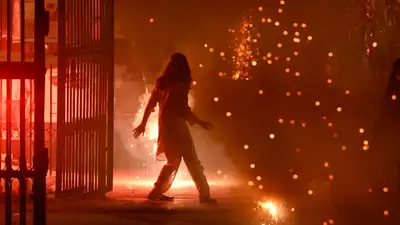
Delhi’s air quality has deteriorated following Diwali, with firecrackers contributing over 80% to pollution levels (Photo credit: Rajesh Mehta/TOI)
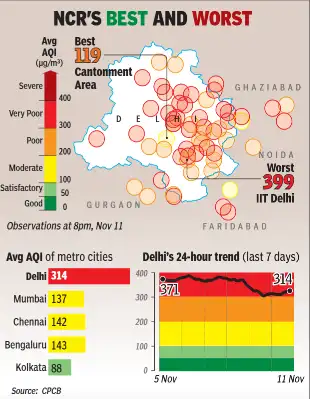
After firecracker emissions accounted for over 80% of Delhi’s pollution load on Monday, they remained a dominant source on Tuesday, contributing 22%, according to Indian Institute of Tropical Meteorology’s real-time source apportionment data. On Wednesday, the share of emissions from firecrackers between 1am and 9am dipped to 7.4%. Air quality remained in the very poor category, with an AQI of 313 at 4pm Wednesday when Central Pollution Control Board (CPCB) releases its 24-hour average AQI bulletin. It had briefly dipped to 299 in the higher end of the poor range Tuesday after winds picked up. At 414, DTU was the lone station Wednesday to record ‘severe’ air quality. NCR’s best and worst With consistent northwesterly winds expected to prevail, the contribution of stubble burning is forecast to rise to 20.3% Thursday. Data from IITM’s real-time source apportionment shows that after firecrackers were used during Diwali, they became the top source of pollution in Delhi Sunday, contributing 43.4%. The share of emissions from firecrackers rose to over 80% between 1am and 9am Monday. The entire day’s share, however, was 71.1%. Supreme Court had permitted the use of only green crackers during two slots: 6am to 7am and 8pm to 10pm on November 7 and 8. Tuesday, after firecracke-rs, secondary organic aerosols contributed around 17.5%, followed by wood burning at 14.3%, according to IITM’s data. On Wednesday, the top source impacting Delhi’s air quality from 1am to 9am was secondary organic aerosols, at 22.7%, followed by domestic solid biofuel burning or dung-cake at 22.3%, vehicles at 19.3%, secondary inorganic aerosols at 11.9%, mixed combustion at 10.6% and firecrackers at 7.4%.
TOI had reported that markets in the ci-ty were flooded with conv-entional firecrackers with fake green labels. Secondary organic aerosols form when volatile organic compounds released by sources such as vehicles, industries, solvents and vegetation react with other substances in the air, creating particulate matter. You Can Also Check: Gold Rate in Delhi | Silver Rate in Delhi | Bank Holidays in Delhi | Public Holidays in Delhi | Delhi AQI | Weather in Delhi | Petrol Price in Delhi | Diesel Price in Delhi | CNG Price in Delhi | LPG Price in Delhi Stay updated with the latest Delhi news.
NEW DELHI: The impact of the widespread use of firecrackers has lingered after Diwali. The air quality is expected to remain in the very poor category over the next two days. The restriction on the use of crackers was widely flouted, with firecrackers lighting up the sky till early Sunday morning. it still impacted the city’s air quality While the contribution from emissions from firecrackers started dipping from Tuesday. Secondary inorganic aerosols develop when gases such as sulphur dioxide, nitrogen oxides and ammonia undergo chemical reactions in the atmosphere, producing particles like sulphates and nitrates. Download the TOI App.