
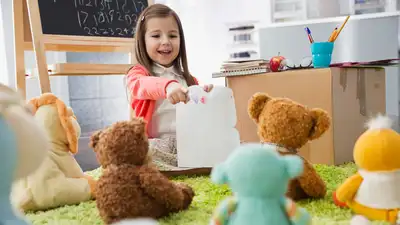
Photo: Canva
5 Oct 2026 | 12:06 Children cannot yet be doctors, teachers, or parents, so they borrow those roles in play and try them on, the way we try on a coat that is a size too big. A 2024 meta-analysis in Educational Psychology Review explains the thinking. A study from the University of Virginia’s Early Development Lab found that children strongly preferred real activities over pretend ones, though 3- to 4-year-olds liked pretend roles. A well-known 2013 review in Psychological Bulletin by Angeline Lillard and colleagues looked at the claims and raised the possibility that characteristics of the child, the adult, and the environment, rather than play itself, are the real causes.
A little girl lines up her soft toys on the bed, puts on a stern face and says, “Sit properly. Her brother, meanwhile, listens to a teddy bear’s chest with a toy stethoscope and says that it needs medicine. So when a child plays “school,” they are not only copying.
No talking in class. In the next room, a child feeds a doll and scolds it in exactly the way her mother does. Most parents smile at moments like these. Sometimes we also get embarrassed a little when we hear our own words and tone coming back at us. It is funny, but it also makes us wonder: where do they get all this from? And is it just play, or are they telling us something? So what does this kind of play actually show about how children see the adult world, is it just fun and play, or is there something more to it? Let’s see what psychologists have to say. The most famous theory comes from the psychologist Lev Vygotsky, from a study published by the University of Virginia; he believed that in play, “it is as though [the child] were a head taller than himself. In other words, children use pretend play to practise adult roles they can’t take on yet. In this view, children re-enact the world around them, and they take on roles such as teacher, doctor, store owner or customer. they also practise negotiating play themes, social roles and rules While doing so. They are working out who gets to speak, who gives the orders, and what the rules are. That fits with the idea that taking on a grown-up role can feel especially exciting for young children. But these games and enactments are not the same across the world; in cultures where adults don’t value it as much, children pretend far less. So the games we see are influenced by the adults and the world around the child. Many people say that role play makes children smarter, kinder, or better at understanding others. On the contrary, writing for SAGE, researchers note that the problems Lillard pointed out are real, but that scientists keep studying how make-believe may help children’s self-regulation. So the debate is still open. You use AI every day. Now get your AI Quotient. Take the AIQ test Get the latest Lifestyle News and more. Download the TOI app.