

Photo: Vesna Vulović (1972)Photo credit: Shutterstock
A young flight attendant, caught in an explosion at cruising altitude, fell from more than 10,000 metres and lived. Because it sits at the edge of what seems possible, her story endures. The record she holds is not just a statistic. It is a reminder of how fragile life can be, and how occasionally, against every expectation, it survives. You use AI every day. Now get your AI Quotient. Take the AIQ test.
On 26 January 1972, a Yugoslav Airlines flight broke apart in the sky above Czechoslovakia after an explosion tore through the aircraft. Among the 28 people on board, only one person lived: 23-year-old flight attendant Vesna Vulovic. She fell from an altitude of 10,160 metres, or 33,333 feet, and survived without a parachute, a feat that still stands as the record for the highest fall survived, according to Guinness World Records . Vulovic was working as a Jugoslavenski Aerotransport hostess aboard a Douglas DC-9 flying from Stockholm to Belgrade. The official accident report stated that the blast tore the DC-9 apart in midair, scattering wreckage across a remote, wooded area of Czechoslovakia, now the Czech Republic. All 27 other passengers and crew members died in the disaster. Meet Vesna Vulovic, the only survivor after free-falling 33,333 feet after a plane crash (image- Guinness World Records official website )
The story sounds almost impossible, yet it is documented in official accident records, contemporary reporting and later accounts of her life. Vulovic was found amid wreckage on a snow-covered mountainside near Srbska Kamenice, injured so severely that doctors did not expect her to live. She spent years recovering, but eventually returned to work and became one of the most remarkable survivors in aviation history. The aircraft had stopped in Copenhagen before continuing its journey, and it was during this stopover that investigators suspected an explosive device had been placed on board. Shortly after the plane left Copenhagen, an explosion ripped through the aircraft at high altitude. Vulovic was the sole survivor, a fact that turned an already tragic aviation accident into one of the most extraordinary survival stories ever recorded.
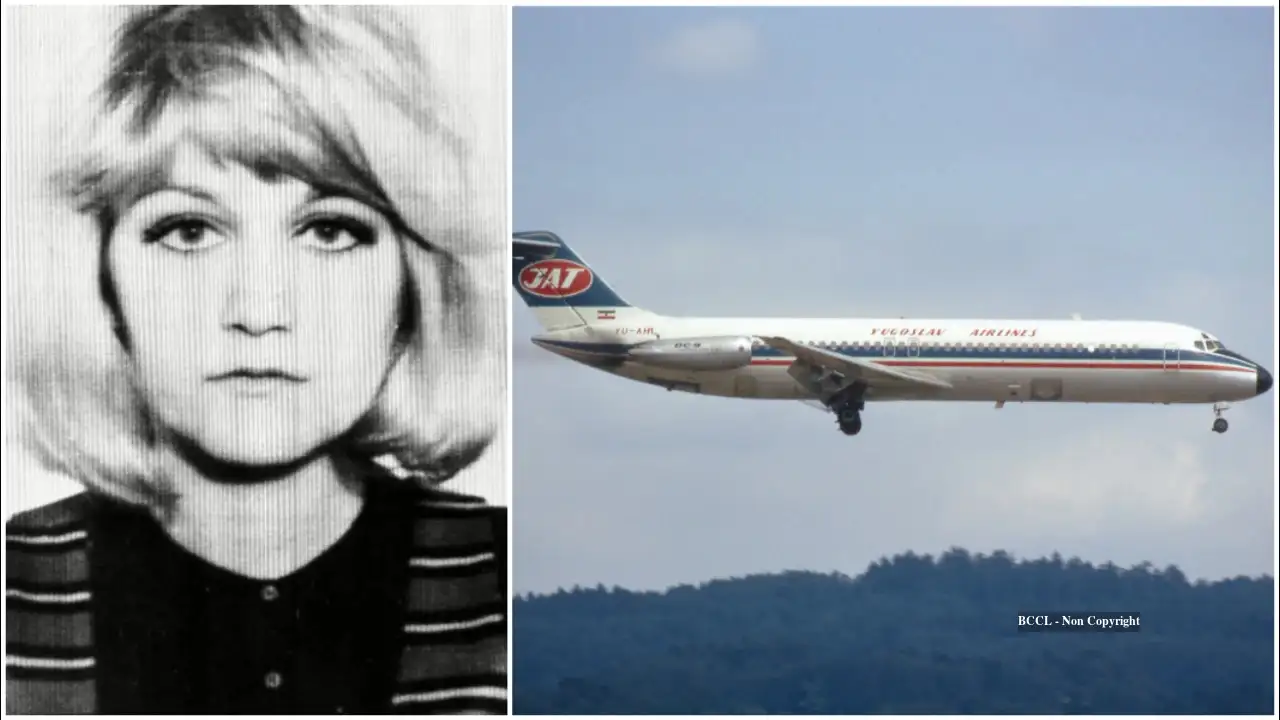
After arriving at hospital, she fell into a coma, and accounts differ on how long it lasted, with Guinness World Records reporting 27 days and the BBC reporting 10 days. Vulovic spent 16 months in hospital after the crash, undergoing extensive treatment and rehabilitation. Investigators believed that Vulovic was trapped by a food cart in the tail section of the aircraft as it plunged toward the ground. That section of the plane eventually landed in a heavily forested, snow-covered mountainside, and the terrain is thought to have softened the impact enough to give her a chance of survival. The snow, trees and angled slope may have acted as a crude but vital cushion. Rather than striking a flat, hard surface, the tail section appears to have come down through terrain that absorbed some of the force of the impact. It is important to understand that surviving such a fall was not simply a matter of luck. The position of the wreckage, the freezing conditions, the way the aircraft broke apart and the immediate rescue all played a role. Even so, the outcome remains exceptionally rare, which is why Guinness World Records continues to recognise it as the highest fall survived without a parachute. Vulovic was discovered by Bruno Honke, a local woodsman who heard her screaming in the darkness while debris continued to fall around him. He found her alive in the wreckage and she was rushed to hospital for emergency treatment. Her injuries were catastrophic. She had suffered a fractured skull, two crushed vertebrae, a broken pelvis, several broken ribs and fractures in both legs. For a time, she was temporarily paralysed from the waist down. Doctors were uncertain whether she would walk again, let alone return to any form of normal life. Her body had been shattered by the impact, and the road back was long, painful and uncertain. Against the odds, she made a near-full recovery. she eventually went back to work for the airline in a desk-based role Although she did not return to flying.
In 1985, Vulovic entered the Guinness Book of Records for surviving the highest fall without a parachute. Guinness World Records officially lists the record as 10,160 metres, set on 26 January 1972 over Srbska Kamenice in what was then Czechoslovakia. In 2009, a journalistic investigation suggested that the plane may have begun an emergency descent before disintegrating, meaning the actual fall distance could have been lower than the official figure. What is known is that the aircraft broke apart in flight, that 27 people died and that Vulovic alone survived. She was dismissed from her airline job in 1990 after taking part in protests against President Slobodan Milosevic. Join conversation Share your thoughts in the comments Be respectful · TOI community guidelines Vesna Vulovic died in December 2016 at the age of 66.
Her death was reported by Serbian state television, though the cause was not immediately known at the time.
“I was broken, and the doctors put me back together again,” she told The New York Times in 2008. She once said that people often wanted to sit next to her on planes, perhaps drawn by the extraordinary story behind her survival. She later described the experience in simple, striking terms. “Nobody ever expected me to live this long. The record has never been broken. none has been documented as surviving a fall from a greater altitude without a parachute While other people have survived falls from extreme heights. There has been some debate over the exact altitude at which the aircraft broke apart. However, even one of the journalists involved acknowledged that the evidence was circumstantial. The suspected bombing was never fully solved. Investigators believed that a device may have been planted on the aircraft during its stopover in Copenhagen, but no one was ever arrested and no conclusive proof was ever established. The lack of certainty has followed the story for decades. The question of who was responsible, and why, remains unanswered. Vulovic became a national figure in Serbia, where her survival story earned her a level of fame few ordinary citizens ever experience. She used that visibility to speak on political issues and became known for her opposition to nationalism. Even after leaving the airline, she continued to speak out on political matters for another two decades. Despite everything she had been through, Vulovic continued to fly as a passenger.