
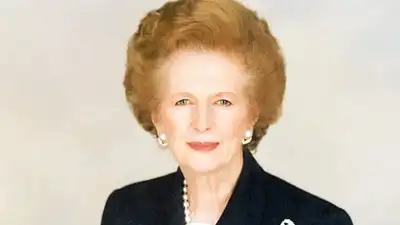
Quote of the day by Margaret Thatcher (Image source: Wikipedia)
In the full exchange, published in Woman’s Own magazine in October 1987, Thatcher was responding to a question about the role of government, and led into the famous line with a specific complaint: too many people, she argued, had come to see personal hardship as automatically the government’s problem to solve, saying “I have a problem, I’ll get a grant” or “I’m homeless, the government must house me,” rather than looking to themselves and their own efforts first. She went on, immediately after the famous sentence, to say that “no government can do anything except through people, and people must look to themselves first,” and that “it’s our duty to look after ourselves and then, also, to look after our neighbour. Thatcher herself, writing later in her memoirs, said the line had been “distorted beyond recognition” by critics who quoted only the opening sentence.
Few political quotations have been fought over as fiercely as this one, and much of that fight comes down to how much of the original interview actually gets included. The remark came near the end of Thatcher’s second term as Prime Minister, during a period in which her government pursued large-scale privatisation of nationally owned industries and significant reductions to the size and reach of the British welfare state, changes that reshaped the UK economy for decades afterwards and remain central to debates about her legacy. Understood in that context, the quote reads less like a one-off aside and more like a compressed statement of the philosophy underlying that entire economic program: that responsibility begins with the individual and the family, and that the state’s role is to work through people rather than substitute for their own effort.
Defenders argue the full quote is closer to an argument for personal responsibility and neighbourly duty than for indifference, and note that Thatcher used the word “society” approvingly elsewhere in her own speeches. Public opinion research offers a striking illustration of just how much the framing changes the reaction. When pollsters at Ipsos tested the isolated sentence against the fuller passage, roughly three-quarters of respondents disagreed with the bare statement alone, while a clear majority agreed with the longer excerpt that included her points about duty and looking after one’s neighbour, a gap that tracked closely with existing political affiliation. Critics argue the quote, even in fuller context, still reflects a philosophy that shifts responsibility for hardship onto individuals and away from collective structures, and that it was used, rhetorically and in policy, to justify real cuts to the social safety net during her time in office. Both readings can be defended from the same interview, which is a large part of why the line has stayed this contested for nearly forty years, rather than settling into a single agreed meaning the way most quotes eventually do.