
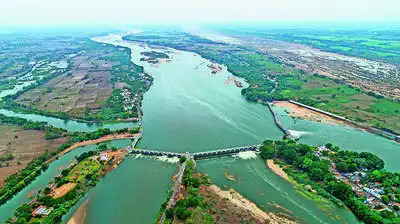
Grand Anicut Canal system in Tamil Nadu
This year too, failure to open Mettur dam on the customary date, June 12, has impacted paddy cultivation in Cauvery delta districts and caused substantial drinking water shortage in districts. This is reportedly the 57th time in the 83-year history of the dam that water was not released on the customary date, 12 of those times being in the past two decades. No major barrage has been commissioned across the Cauvery or its flood carrier, the Kollidam, since the Mayanur barrage near Karur in 2014. Work on the Adhanur-Kumaramangalam barrage, launched in 2019, is incomplete. In 2019, then chief minister Edappadi K Palaniswami too announced checkdams would be built across Cauvery. In Aug 2024, a bed-protection wall across the river was damaged by a flow of just one lakh cusecs. Desilt, desilt, desilt: Mettur dam, the lifeline of Cauvery delta, has lost 30% to 40% of its 93.47 tmc ft design capacity since its commissioning for silting in 1934. At Coimbatore’s Pillur dam, providing over 120 MLD of drinking water to Coimbatore, silt levels have breached 57ft. A recent World Bank–funded survey pegged the accumulated sediment at 26 million cubic metres, and pilot dredging initiatives have failed after floodwaters quickly redeposited fresh silt. Much of Vaigai dam’s capacity remains unutilised as silt has accumulated for about 20ft of 70ft of the dam over 50 years. In July 2024, authorities launched a pilot desilting initiative to extract 25,000 cubic metres of silt using dredgers and geotubes in Pillur dam. For instance, desilting of Mettur dam could roughly cost `3,000cr, say water managers. Tamil Nadu has 39,202 tanks, including 8,939 maintained by the WRD, but there is no systematic desilting and upkeep. CO53 matures in 115 days, CO58 in 120 days and CO59, released in 2025 for the samba season, in 135 days. “We have 10 tonnes of CO59 seeds available, but less than 500kg of the drought-resistant varieties have been sold so far. Direct sowing avoids water-intensive nursery preparation and can cut water use by 15% to 40%. The practice reduces water use by 15% to 25% while maintaining stable yields,” says N Punithavathi, programme coordinator at the Krishi Vigyan Kendra in Sirugamani, Trichy district.
Over the past three decades, water spread has shrunk from 105.2 sq km to 79.8 sq km due to an annual sediment influx of nearly 4.7 million cubic metres. The state govt announced in its budget that a detailed project report would be prepared to build checkdams across Cauvery and Kollidam. Get drought-resistant paddy out of warehouses, into fields: Tamil Nadu Agricultural University (TNAU) introduced three drought-resistant, fine-grain rice varieties with a low glycemic index to help farmers cope with water scarcity. You Can Also Check: Gold Rate in Chennai | Silver Rate in Chennai | Bank Holidays in Chennai | Public Holidays in Chennai | Chennai AQI | Weather in Chennai | Petrol Price in Chennai | Diesel Price in Chennai | CNG Price in Chennai | LPG Price in Chennai Stay updated with the latest Chennai news.
Still, says R Paranthaman, retired PWD chief engineer, check dams or small water storage structures, could be considered across irrigation rivers such as Cauvery. We allow farmers to use alluvial soil from tanks for use in fields, which helps in desilting and increasing the storage capacity,” says a WRD official. But poor awareness among farmers has resulted in limited demand,” says S Manonmani, professor and head department of Rice, TNAU.
the state needs to also explore other ways to shore up its water resources to mitigate crisis during a bad year While Tamil Nadu should continue to fight for its rightful share of Cauvery water. Here are four ideas the state govt can consider: Finish what’s started: Of the Cauvery’s 800km length, 416km flows through TN and 320km through Karnataka. The initiative needs to be fastracked. Experts say there are physical and ecological challenges in building checkdams, especially across Kollidam. Retired WRD officials say they could obstruct surplus flows and cause bund breaches. The terrain and habitations along the river pose challenges too. “For Kollidam, barrages can be built at a distance of 25km from each other. The situation is similar across the state. This leaves an effective water head of just 43ft. Experts say desilting huge reservoirs is a logistical nightmare. The effort failed after heavy floodwaters from the perennial river quickly deposited fresh silt into the excavated areas. In addition, the process involves heavy expenditure. Experts say major tanks fed by Cauvery should be desilted regularly to store surplus river and rainwater and recharge groundwater. “Routine upkeep of these tanks will support groundwater recharge and manage irrigation needs. All require water only until flowering and are moderately resistant to pests and diseases. “These varieties are suitable for areas facing water scarcity. acceptance among farmers for the new varieties is low While TNAU Coimbatore is also developing rice varieties suited to changing climatic conditions. “Govt needs to sensitize farmers on adapting to modern agriculture practices. Promote water-saving irrigation methods: Agricultural experts say Cauvery delta farmers must use medium-duration paddy varieties for samba and short-duration varieties for kuruvai. Experts also promote additional drought-management techniques such as alternate wetting and drying (AWD) irrigation throughout the crop cycle. “In AWD, fields are not kept continuously drenched in water. Instead, they are allowed to dry for several days between irrigations before being re-flooded. “As a part of AWD to minimize water usage, farmers can irrigate periodically only when hairline cracks start forming in their fields. They may also weed the field to help roots proliferate. Only a few farmers are open to attempting modern irrigation techniques, she adds. Download the TOI App.