
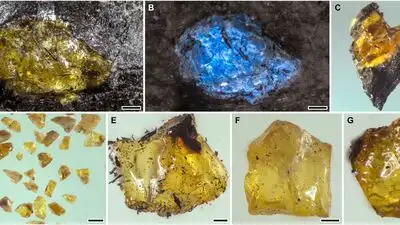
PC: Science Advances (2026). DOI: 10.1126/sciadv.aeh1266
The oldest confirmed pieces of fossilised tree resin, until now, came from rocks dating to roughly 320 million years ago. Amber is usually associated with dinosaurs, prehistoric insects and forests that flourished long after life had become well established on land. That picture has changed with a discovery from north-west China.
Scientists have identified tiny fragments of amber preserved in rocks around 385 million years old, pushing the confirmed fossil record of amber back by about 65 million years. Most fragments measured only between 0.1 and 0.5 millimetres across, with the largest reaching about 1.5 millimetres, making them far smaller than the amber commonly found in younger geological formations. For decades, the oldest widely accepted amber had been dated to the Late Carboniferous period, around 320 million years ago. The Chinese specimens extend that record by approximately 65 million years.
Because it can preserve chemical signatures for hundreds of millions of years, sometimes alongside traces of the environment in which it formed, amber is valued. It suggests that some of Earth’s earliest vascular plants had already developed sophisticated resin-producing systems far earlier than previously confirmed, offering a different perspective on how plants adapted to life on land.
Titled “ The earliest amber from the Middle Devonian of China ”, it does more than add another ancient specimen to museum collections, according to the new study published in Science Advances. Earlier reports from Devonian rocks had hinted at resin-like material, but those examples lacked the chemical evidence needed to confirm that they were genuine fossil amber, according to the authors. The amber represents the oldest chemically verified example ever discovered. The newly identified amber comes from the Middle Devonian Hujiersite Formation in Xinjiang, China, where researchers extracted hundreds of microscopic amber pieces from coal deposits. This discovery provides that missing confirmation through detailed laboratory analysis. Repeated wildfires had already become part of terrestrial ecosystems by that time, while fossil evidence also points to fungal pathogens infecting early land plants. Those hazards may have created strong evolutionary pressure for plants capable of sealing wounds quickly and limiting infection. Evidence for widespread insect feeding on vascular plants appears much later, making fire damage and disease more likely drivers behind the earliest development of resin production. Even though these newly discovered fragments are tiny and contain no trapped insects or other spectacular inclusions, they still offer rare evidence of biological innovation during a key stage in the evolution of terrestrial ecosystems.