
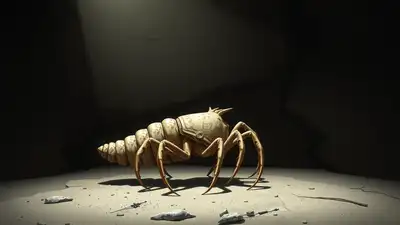
Scientists have identified the earliest known evidence of spider fangs in a 518 million-year-old fossil recovered from southern China, tracing the origin of one of the animal kingdom’s most feared biological tools back to a small marine creature that lived long before spiders existed. The fossil belongs to a species called Urokodia aequalis, examined by researchers from Yunnan University and the University of Leicester using X-ray imaging techniques that revealed soft tissue structures preserved inside the rock. The findings, published in the journal Nature, show that pincer-like limbs on this ancient animal represent the earliest known stage in the evolution of chelicerae, the specialised front limbs that eventually developed into the fangs of spiders and the pincers of scorpions. It’s a rare thing to catch evolution mid-sentence like this, a small pincer on a two-centimetre sea creature slowly becoming, over hundreds of millions of years, the fang now feared in gardens and basements everywhere.
Professor Yu Liu of Yunnan University, who led the study, said the team had been using X-ray tomography to examine the fossil’s soft anatomy when they noticed the pincer-like limbs near the front of the animal, immediately recognising the specimen as a distant ancestor of living chelicerates such as scorpions and spiders. The technique allowed scientists to see soft anatomy that had remained hidden inside the surrounding rock for more than half a billion years, revealing a seven-segmented head along with a pair of small pincer-like limbs positioned just behind the animal’s eyes. Beyond the chelicerae, the research also identified features in Urokodia’s trunk limbs that resemble early book gills, the layered respiratory structures still found in modern horseshoe crabs.
The discovery helps fill a long-standing gap in the fossil record, since earlier proposed ancestors had left the exact transition from simpler limbs to true chelicerae unresolved. This combination of pincer-like front limbs and gill-like trunk appendages strengthens the case that Urokodia represents an early branch on the evolutionary path connecting ancient marine arthropods to the diverse chelicerate group alive today, according to the study.
The findings offer palaeontologists a clearer framework for testing how chelicerates are related to one another and how their distinctive anatomical tools evolved over time. The research was published on the 42nd anniversary of the discovery of the Chengjiang fossil site, a location that continues to yield new insights into the earliest chapters of animal evolution more than four decades after it was first uncovered. For scientists studying how complex features such as fangs and gills first emerged, Urokodia offers a rare example of a structure caught mid-transformation, showing that some of the animal kingdom’s most distinctive tools took shape gradually rather than appearing all at once.
Researchers involved in the study noted that some relationships among other early chelicerate relatives remain unresolved and will need further fossil evidence to confirm, but the new reconstruction provides a rare fossil that appears to bridge a significant anatomical gap between early Cambrian arthropods and the chelicerates seen today.