
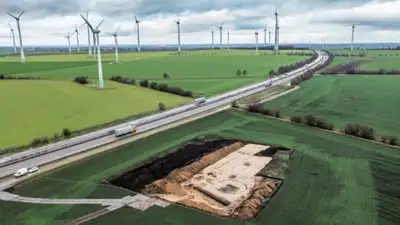
PC : State Office for Heritage Management and Archaeology Saxony-Anhalt
Archaeologists excavating near Nauendorf in Saxony-Anhalt, Germany, have uncovered the remains of two very young horses deliberately buried beside a Late Bronze Age burial mound, offering rare evidence of ritual animal sacrifice more than 3,000 years ago. They then unexpectedly discovered a horse buried in the ditch, followed 11 metres northeast by a second horse placed in the same orientation as the human graves. Radiocarbon dating places the 2 deposits in essentially the same period. The first foal produced a calibrated date of 1212–1055 BCE, while the second dates to 1211–1052 BCE, both within the beginning of the Late Bronze Age.
The discovery was made during archaeological investigations ahead of construction of the SuedOstLink electricity transmission line, which exposed a prehistoric landscape containing settlements, graves and other features. At the centre of the find were the remains of a burial mound dating to the beginning of the Late Bronze Age, although the mound itself had long since disappeared beneath the flat landscape. Archaeologists identified its former outline from a circular ditch and found two stone-lined human graves inside the enclosure itself. Both animals were foals only about five to nine months old when they were deliberately deposited. The excavation took place at Nauendorf in the northern Saalekreis district as part of archaeological investigations preceding construction of the SuedOstLink electricity transmission route. The wider site contains evidence of a settlement landscape dating from the Late Bronze Age and Iron Age, including house locations, storage pits, oven pits, ditches and a burial ground. Among the earliest features was a burial mound dating to the beginning of the Late Bronze Age. One foal has another unusual feature. Its hind-leg bones lie almost parallel to each other, which archaeologists interpret as a possible indication that its body had been bound or constricted around the hindquarters before burial. This remains an interpretation rather than proof of exactly how the animal was handled or killed. Horses had a status in Bronze Age societies that extended well beyond their value as ordinary livestock. The State Office notes that their importance increasingly shifted during the Bronze Age from that of a food animal toward that of a prestige object associated with wealth, mobility, religious beliefs and burial practices. Evidence for this changing status appears in rock art, decorated pottery, bronze objects and elaborate horse harnesses deposited in graves and hoards.
The State Office describes the discovery as a previously singular example of the ritual deposition of such young horses during this period.
Inside the enclosure were 2 elongated, stone-lined graves. Both horses were exceptionally young foals, approximately 5 to 9 months old. More than 3,000 years later, the 2 foals preserve evidence of that decision in the archaeological record.
Because centuries of erosion and agricultural activity had flattened the landscape, the mound itself was no longer visible as a raised feature. The excavation therefore revealed not simply isolated horse remains, but an unusual concentration of animal and human funerary features within the same archaeological monument. Because of their young age, the surviving skulls and long bones show that the animals were originally deposited as complete carcasses rather than as selected body parts, although their skeletons were only partially preserved, particularly. Deliberately sacrificing and removing 2 such animals from future use would therefore have represented a meaningful expenditure of resources. Because horses were involved, but because 2 very young animals appear to have been deposited as complete carcasses in direct association with the same burial monument, the Nauendorf discovery is therefore unusual not simply.
Comparable examples have been reported only sporadically in the neighbouring Lusatian cultural area, where horses associated with funerary practices appear to have been cremated and their remains placed in ceramic vessels. Archaeologists could nevertheless identify its former location from the circular ditch surrounding it, with an earthen bridge or entrance surviving on the eastern side. Both were lying on their right sides with their limbs naturally bent. That makes the age of the Nauendorf animals particularly significant. A foal only a few months old represented an animal with years of potential economic value ahead of it. The archaeological interpretation is that their sacrifice may reflect the importance of the funerary ritual and potentially the elevated status of the people buried beneath the mound. The exact religious meaning, however, cannot be established from the surviving evidence. The archaeologists can identify the deliberate deposition, the animals’ young age, their placement near the mound and their relationship to the human graves, but they cannot reconstruct precisely what the ceremony meant to the people who carried it out. Saxony-Anhalt already has numerous archaeological finds showing that horses or horse parts could form part of prehistoric funerary practices. The State Office specifically cites discoveries at Esperstedt, Burgsdorf and Großpasleben, among other sites. Those discoveries include individual horse bones, skulls and lower-leg bones, as well as combinations of selected skeletal parts. Complete horse burials from this period are considerably rarer. The discovery provides a rare physical glimpse into how Bronze Age communities connected animals, status and death. The horses were not simply discarded remains: their deliberate placement within the area of the burial mound, their alignment and their young age all point toward a purposeful act. The strongest interpretation from the archaeological evidence is that the animals were sacrificed as part of a ritual connected with the burial monument. Their sacrifice may have expressed the status of the people buried there, accompanied the deceased symbolically or fulfilled another religious purpose that is now impossible to reconstruct. Their bones show that horses could occupy a place in Bronze Age funerary practice that went far beyond their practical economic value. Catch the latest World News and Live updates. Download the TOI app.
When the excavation area was expanded, researchers discovered a second horse only 11 metres northeast of the first. The second animal had also been deliberately placed on its side and was oriented identically to the 2 stone-lined graves inside the burial mound. Such pits can contain later human burials, but in this case the excavation revealed a horse lying on its right side instead.
Archaeologists initially encountered the remains of a horse in a deeper pit cut into the southeastern section of the circular ditch. The State Office for Heritage Management and Archaeology Saxony-Anhalt describes this alignment as an obvious reference to the graves, providing strong evidence that the horse burial was deliberately connected to the funerary monument rather than being an unrelated animal deposit.