
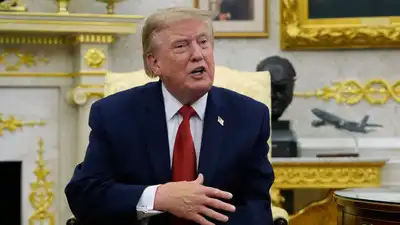
“If Oman gets in the way, we’ll bomb the s*** out of them,” Trump told Fox News (AP Photo)
US President Donald Trump has again threatened to strike Oman, accusing the Gulf nation of potentially standing in the way of an agreement with Iran, as negotiations over the future of the Strait of Hormuz remain stalled and a 60-day US-Iran interim arrangement expires without a permanent deal. The latest developments came on the day the 60-day period under a US-Iran memorandum of understanding was due to expire. Because it could give Iran and Oman a greater role in determining how ships move through the waterway, the proposed arrangement has alarmed Washington. The latest threat therefore marks a renewed escalation in Trump’s rhetoric towards a country that has historically maintained close relations with Washington while also preserving diplomatic channels with Tehran.
“If Oman gets in the way, we’ll bomb the s*** out of them,” Trump told Fox News on Monday, according to Reuters. Look, we’re in there for one reason: Iran cannot have a nuclear weapon,” he told reporters. Asked whether Washington was seeking an extension of the interim agreement with Tehran, Trump said “no. “The number one Goal is, and always will be, that Iran cannot have, in any way, shape, or form, a Nuclear Weapon,” Trump wrote. Trump declared it “over” on July 7, while Iran’s foreign ministry said a week later that it had been “suspended”. Iranian foreign ministry spokesperson Esmaeil Baghaei said the proposed arrangement would seek to protect the interests of both countries while allowing commercial vessels to pass safely. “This is the first time that a mechanism is being developed to simultaneously safeguard the sovereign rights of the two littoral states and ensure the safe passage of commercial vessels,” Baghaei said. Trump has also said there should be no tolls for vessels passing through Hormuz unless they are collected by the United States. It’s international waters, and Oman will behave just like everybody else, or we will have to blow them up,” Trump said at the time.
The threat places Oman, a longstanding US partner and one of Washington’s traditional channels for communicating with Tehran, at the centre of the growing dispute over the strait. It also marks the second time in recent months that Trump has threatened military action against Oman over the issue. Trump’s warning came as his administration’s efforts to secure a broader agreement with Iran appeared to have stalled. “They’re not going to make the kind of a deal that I feel is necessary. The US president also repeated on Truth Social that preventing Iran from acquiring a nuclear weapon remained his administration’s central objective. The agreement had committed both sides to negotiating a final arrangement covering broader issues, including Iran’s nuclear programme. However, the arrangement quickly unravelled. Oman’s role in the crisis is closely linked to the Strait of Hormuz, which separates Iran from Oman and has become one of the most important pressure points in the conflict. For the Trump administration, the issue is not simply about reopening the strait. Washington has demanded that Iran relinquish control over shipping routes and has opposed any arrangement that could allow Tehran to impose charges on vessels. US Secretary of State Marco Rubio has warned that Iran must not be allowed to impose tolls on ships using the strait. Trump’s latest warning is not the first time he has threatened Oman over the Strait of Hormuz. In May, he was asked about a proposal under which Iran and Oman would jointly oversee shipping through the waterway. “Nobody is going to control it. There was initially speculation that Trump might have meant Iran rather than Oman. However, the US State Department later published the remarks along with a transcript that explicitly referred to Oman.
Trump’s latest warning came as Oman and Iran moved closer to an understanding on the reopening and management of commercial shipping through the Strait of Hormuz, a vital waterway through which about one-fifth of the world’s oil and liquefied natural gas supplies passed before the war. Iran and Oman have been negotiating a mechanism to restore commercial shipping through the strait after the earlier US-Iran arrangement broke down. Speaking to reporters in the Oval Office on Monday, Trump said Tehran would not accept the agreement he believed was necessary to end the conflict. Earlier on Monday, Trump had told Fox News that Iran should surrender and put pressure on Tehran to accept Washington’s terms. On Monday, Iranian officials said Tehran and Muscat had reached an understanding on a new shipping route and were preparing a joint declaration.
Around 130 ships passed through the strait each day, according to the background material cited in the reports. Brent crude, which was trading around $66 a barrel before the conflict, has risen sharply during periods of heightened tension, at times crossing $100. Brent crude futures stood at $91.22 a barrel on Tuesday, according to the source material, close to a three-week high.
Because it gives Muscat access to Iranian officials and allows it to mediate when direct US-Iran talks are not possible, others view Oman’s longstanding relationship with Tehran as an advantage.
“Midterms have nothing to do with my thinking,” he told Fox News. Earlier this month, he said he would consider declaring the waterway US territory after claiming that Iran was being defeated. “After we finish defeating Iran, which is being very badly defeated, pretty soon I’ll be declaring the Hormuz Strait a territory of the United States,” Trump said on August 14. Deputy Foreign Minister Kazem Gharibabadi said the strait could not be taken over through a social media post, an aircraft carrier or a political declaration, and said Iran was not intimidated by US military power.
Oman has traditionally followed a policy of neutrality in regional conflicts and has played an important role in facilitating communication between the US and Iran. The country has longstanding defence and economic ties with Washington, including security cooperation and a free trade agreement. At the same time, Muscat has maintained close diplomatic relations with Tehran. That position has allowed Oman to act as a mediator in previous US-Iran disputes. Its role has become more complicated since the conflict began. Iran has targeted US military assets and infrastructure across the region, while Oman has sought to prevent the Strait of Hormuz from becoming permanently closed to commercial shipping. Oman has not publicly aligned itself with either side in the dispute over the waterway. Its current talks with Iran are focused on restoring commercial traffic and establishing a mechanism for ships to safely navigate the strait. But any arrangement that gives Iran a formal role in determining shipping routes could conflict with Washington’s demands. The Strait of Hormuz is one of the world’s most strategically important maritime chokepoints. The conflict has sharply disrupted that traffic. Iran closed the strait in early March, allowing only vessels it considered friendly to pass. Shipping briefly improved after the June US-Iran memorandum, but tensions over the routes used by commercial vessels soon triggered fresh confrontation. Iran later refused to resume direct negotiations with Washington, arguing that the US had violated the terms of the agreement by continuing military operations. The dispute has also affected energy markets. Washington has also established a blockade around Iranian ports in and near the Strait of Hormuz. Last week, US forces fired on a Panama-flagged cargo vessel that Washington accused of attempting to reach Iranian ports and failing to comply with orders to change course. The confrontation has created another obstacle to reopening the waterway. Iran wants guarantees against further US attacks and has demanded sanctions relief as part of any broader settlement. Washington, meanwhile, wants Iran’s nuclear programme curtailed and the strait fully reopened without Iranian control over commercial passage. Oman’s attempt to bridge those positions has put Muscat in an increasingly difficult position. The Trump administration appears divided over Oman’s role. Some US officials have accused Oman of being too accommodating towards Iran and fear that a Tehran-Muscat agreement could produce terms more favourable to Iran. The emerging Iran-Oman arrangement could also undermine Washington’s negotiating position if it establishes a separate mechanism for managing the strait without direct US involvement. Trump has already complained that allies and partners are not doing enough to support his campaign against Iran. The issue has also taken on a domestic political dimension, with rising fuel prices and pressure over the economic impact of the conflict as the November US midterm elections approach. Trump has denied that the elections are influencing his Iran strategy. Trump has also taken a more direct position on the future status of the Strait of Hormuz. Iran rejected the suggestion. The disagreement reflects the larger dispute behind Trump’s latest threat to Oman. For Washington, reopening Hormuz is tied to limiting Iran’s ability to use the waterway as leverage. For Tehran, control over navigation through waters adjoining its territory remains linked to sovereignty, security and its broader demands for an end to US military action. Oman is now attempting to negotiate a path between those competing positions. For Trump, however, any agreement that allows Iran and Oman to determine the future of the strait without US approval risks becoming another obstacle to the deal he wants with Tehran. His latest threat shows how the dispute over a narrow waterway has evolved into a much broader confrontation involving Iran’s nuclear programme, US military strategy, global energy supplies and the diplomatic role of one of Washington’s traditional Gulf partners. Catch the latest World News and Live updates. Download the TOI app.
Before the conflict began, roughly one-fifth of global oil and LNG supplies moved through the waterway.