
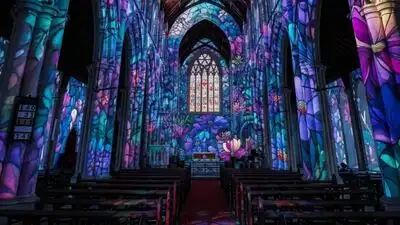
A light projection event at the Afghan Church animates its historic architecture with art.
Titled Ascension — cueing its spiritual and spatial profile — the light projection will cast themed images on the interior and exterior of the building, and by inviting visitors to take in the art from its rosewood pews, turn the monument into an inhabitable artwork. Staged by Floating Canvas Company, Ascension is the eighth installation — and the first within a Grade I heritage structure — in their Mumbai Light Festival, a public art initiative that transforms urban spaces with art-tech interventions.
Upcoming Projection Mapping Event at Afghan Church
This week, the 178-year-old Afghan Church in Colaba will host a projection mapping event. This artistic display will illuminate the Kurla stone of the neo-Gothic structure with innovative light techniques. The event aims to rekindle the joy of exploring the city and appreciating its architectural beauty, reminiscent of the art of flânerie, or leisurely strolling through urban spaces.
Ascension opens to the public today and continues till Aug 29, 7-10pm, Glossary of the Architecture of Bombay will be launched on Aug 29, 4 pm, at Nalanda Learning Centre, CSMVS You Can Also Check: Gold Rate in Mumbai | Silver Rate in Mumbai | Bank Holidays in Mumbai | Public Holidays in Mumbai | Mumbai AQI | Weather in Mumbai | Petrol Price in Mumbai | Diesel Price in Mumbai | CNG Price in Mumbai | LPG Price in Mumbai Stay updated with the latest Mumbai news.
“The idea occurred to us about a year ago, when we were collaborating with the World Monuments Fund on documenting some of their restoration initiatives across India,” says Shakti Swarup Sahu, Creative Director at Floating Canvas Company. The experience is intended to evoke awe and introspection: “Moving through cosmic landscapes and abstract symbolism, the experience invites the viewer to question where the journey truly takes place,” says Sahu. Some elements cohabit the same building, says Smita Dalvi. “When you look at a building, you should know its different parts and contextualise it to its time,” says Mustansir Dalvi. “Those buildings freely gave themselves to the appreciation of citizens, who participated in their architecture as a backdrop to their lives,” observes Mustansir. Our times today are more plural,” says Mustansir, adding wryly “To call our contemporary buildings a style would be a stretch.
“Unlike our previous projects involving heritage monuments, where we had mapped their exterior with light projections, the scale and expanse of the Afghan Church made it a great candidate for hosting an immersive art-tech experience indoors. ” Every projection mapping project begins with a close reading of the space. “We did a detailed recce of the church. Every interesting arch, ceiling detail and piece of glasswork was documented while developing the concept and visuals,” Sahu continues. The setup took two to three days and involved ten to fifteen high-resolution projectors, sound systems, consoles, fabrication and calibration. “Outward into the universe, or inward into ourselves? Authored by professors of architecture Mustansir and Smita Dalvi and illustrated by architect and graphic designer Shah Faisal, the book is published by CSMVS as part of the museum’s Digital Library of Mumbai’s Built Heritage project. The glossary collects terms that explain the elements of buildings defined by the city’s five key architectural styles: Domestic Vernacular, Neo-Classical, Neo-Gothic, Indo-Saracenic and Art Deco. The book begins with a foundational essay on construction systems before launching into five thematic chapters, each opening with an essay on the characteristics, origins and sociocultural underpinnings of that style, then expanding into its glossary. It also guides readers to where they may find examples of these elements in the city. “A building like Anjuman-I-Islam in Fort has elements of both Neo-Gothic and Indo-Saracenic. I think there was a lot of free spirit in Bombay at the time that allowed architects to articulate a building the way they wanted to. Conceived as an A5 handbook with labelled and annotated photographs and illustrations, the glossary is easy to carry around and whip out when walking past a built token from another time. “You should also know how these parts come together and what makes the building stand as a structural object. Previous styles engaged directly with the street. “The difference now is that we are building away from public reality. The newer buildings confront us with tall walls; they look as if they don’t belong to the city, but to enclaves in and of themselves. ” What style defines Mumbai’s current buildings? “Styles are largely self-similar; they are comprehensible and reflect the spirit of their times. Download the TOI App.
Metaphysics rearranges itself into lines and letters as the Afghan Church reemerges on a page of the newly published ‘Glossary of the Architecture of Bombay’, whose launch at CSMVS on Saturday marks the second event.