
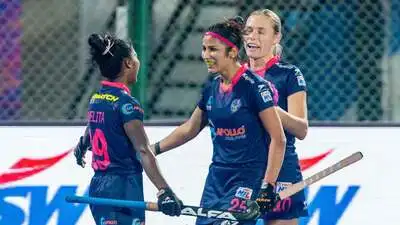
(From left) Sunelita Toppo with Navneet Kaur and Kaitlin Nobbs during the Women’s HIL early this year
When the Indian men’s hockey team ended a 41-year wait for an Olympic medal at Tokyo, the Hockey India League, which ran from 2013 to 2017, was cited as one of the factors behind the turnaround. Sunelita Toppo, for instance, played alongside Navneet Kaur for SG Pipers, which won the 2026 Women’s HIL.
It has increased our confidence and helped us understand different match situations and movements,” said Lalremsiami, who will be playing in her third World Cup. The strikers gave me feedback that if we could improve that connection, we could create better chances and score more goals,” said Sunelita. “I mostly link up with Navneet on the left, and they told me that if I could improve my body control and speed control, it would be a big benefit for the team.
For the women, the biggest gain has been exposure — to foreign players, different styles of hockey and situations that are difficult to replicate during a national-team camp. “I think every player in our team has benefited from Women’s HIL. That exchange of knowledge is perhaps even more significant for the younger members of the Indian squad. It helped the two develop an understanding that they have now carried into the national team. “Sometimes, when I was running and trying to pass, the ball would go too fast or too slow, so the connection wasn’t always right. So, yes, I received that feedback and worked on it.”
Now, the women’s team too has something similar to draw experience from with the introduction of Women’s HIL last year.