
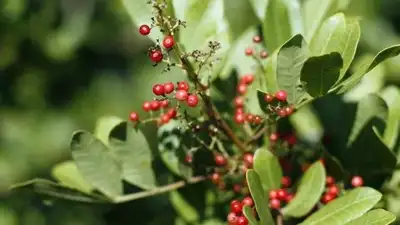
In 1940s Florida, a South American tree was planted as an ornamental; today, Brazilian pepper is one of the state’s worst invasive plants.
You might even have heard it being called “Florida holly.” Back in the 19th century, people in Florida had a knack for importing pretty things from somewhere else, hoping to make the landscape just a little more lush. That’s how Brazilian pepper entered the scene: a bright, glossy shrub with clusters of red berries.
Brazilian pepper still covers more than 700,000 acres in Florida and, despite all the warnings, it turns up every year in home gardeners’ wish lists online. Biological control took decades to develop, and now, tiny insects called thrips are being released in hopes they’ll chew the thickets down.
The plant actually comes from South America: think Brazil, Argentina, Paraguay, according to the Florida Department of Agriculture and Consumer Services. In the Everglades, entire patches that once held dozens of species are now done in by “Florida holly” walls. Now, you’d think something called “holly” would be safe. But no one pretends this is a battle you can “win,” just one you can slow down.
Brazilian pepper wasn’t content to stay put. Before anyone realized, this little beauty became a menace, transforming into one of Florida’s worst invasive plants. Nobody’s completely sure who brought it or when, but by the late 1800s, horticulturalists were already offering it as an ornamental. It was evergreen, fast-growing, glittered with red berries at Christmas, and, perhaps most importantly, seemed happy with swampy heat. So people kept planting it. Only in the wild, things don’t like to stay tidy. By the 1950s, Brazilian pepper started popping up outside cultivated gardens. It didn’t stop. The plant’s seeds hitched rides with birds and raccoons, floated down streams, and before long, covered pastures, pine forests, wetlands — anywhere the sun shines, and people are slow to catch on. So what made Brazilian pepper so unstoppable? For starters, nature gave it an arsenal: dense growth, tough and thick leaves, and the ability to pop seedlings practically everywhere. Birds gobble up those tempting red berries and spit the seeds across Florida. And in case you try to pull it, you’ll see stubborn shoots pop back up from the roots. The plant even releases chemicals in the soil to push out its competition. It’s evergreen, so the shade just keeps getting denser all year round, squeezing out native plants and all the wildlife that depends on them. But here’s a twist: Brazilian pepper comes from the same family as poison ivy. Touching it can cause rashes and allergies in sensitive people. Some folks even react to the berries in the air. So, it’s not just an ecological headache; it can mess you up personally, too. Taking on Brazilian pepper is a full-time job in Florida. Authorities try everything: chain saws, heavy-duty herbicides, even bringing in specialist bugs from South America. Mechanical removal? The plants bounce back if you miss even a nub of root. Chemical sprays? Those come with their own problems for sensitive habitats. What’s left of Brazilian pepper is now a cautionary tale: what started as garden ambition could end up rewriting the landscape. Florida law bans selling or moving the plant without a permit now, but its berries are already part of the state’s bird diet, its seedlings waiting wherever people let their guard down. It’s a lesson in how beautiful things, left to their own devices and with the right weather, can remake an ecosystem, and sometimes, a little too completely. Looking for trusted parenting advice? Follow TOI Parenting Circle on Instagram for expert guidance, relatable stories, and practical tips delivered every day.
For a while, it was just another garden ornament, the kind of thing you’d tuck next to the fence for a splash of winter color. But you know how some guests just never stop spreading?