
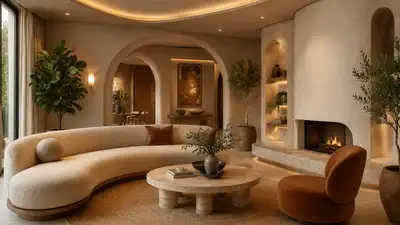
A wall meeting another at 90 degrees sets the dimensions of a room or so it seems. In interior design, every element is a visual cue. Loosen that grid, and you’re asking the mind to look beyond those dimensions. That’s precisely what curved walls do.
A curved wall removes the hard stop we call an edge. Think of it as a comma instead of a full stop. A comma invites more; a full stop shuts the conversation down. Narrow corridors that arc feel palatial, wider than they actually measure. A soft curve where wall meets ceiling can make a room feel taller and more open than an identical straight-walled room of the same square footage. With no flat plane to stop it, the eye keeps travelling along the curve, imagining space beyond it. It isn’t just mind play. Light behaves differently too. On a flat wall, light hits and stops. On a curve, it glides by bending and casting shadow gradients instead of hard lines. That’s part of why curved spaces feel calmer: the light itself has less edge to it. And it turns the wall into something more than a boundary. It becomes a piece of art in the room, without overpowering anything else in it. A wall is no longer dead space waiting to be decorated. It’s a fluid surface you actually want on display. More importantly, curves are simply more human. Minimalism favoured sharp lines and orthogonal grids, but the body doesn’t work that way, and neither does nature. Think undulating rivers, rounded hills, the curve of an eye, the line of a lip. Nothing in nature is a perfect square. A curved doorway, an arced reception wall, a rounded room corner changes how you move through a space, not just how it looks. Curves aren’t about softness for its own sake. Rather they are a distinct signature of design that reads as human, not robotic. The real skill lies in integrating curves with intent, so a room gains a sense of luxury without losing an inch of usable space. A living room wall that tapers into a corridor, or a curved wall separating kitchen from dining, keeps movement free-flowing while giving the home an enhanced sense of spaciousness and grandeur. Curves aren’t only about design and luxury, they hold up better, too. Think of every chipped wall corner in an older home. Round that edge to the right radius, and wear and tear drops with it, giving your interiors a longer life. One caution worth remembering: match your skirting to the wall’s shape. Skip that detail, and you’ve traded a statement curve for an amateur mistake. Purva Gokhale, Concept Designer and Founder, D20 Elements Looking for trusted parenting advice? Follow TOI Parenting Circle on Instagram for expert guidance, relatable stories, and practical tips delivered every day.