
https://basin.ktb.gov.tr/TR-472351/karahantepede-11-bin-yillik-benzersiz-heykel.html
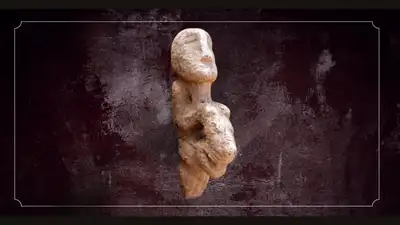
Turkey’s Minister of Culture and Tourism , Mehmet Nuri Ersoy, announced the discovery on August 25, calling the piece a composite sculpture done in a style unlike anything seen before at the site. In other words, it was sitting right where somebody set it down roughly 11,000 years ago and just never moved it again. The find comes from Karahan Tepe, a Neolithic site near Şanlıurfa in southeastern Turkey, part of the same cluster of extraordinarily early settlements that includes the famous Göbekli Tepe. What makes this one extra interesting is the context. The statue wasn’t dug up loose from rubble or fill. It turned up on a stone bench running along the wall of a small, round building about ten feet across, with a floor paved in flat stones. That kind of undisturbed placement is rare, and it gives archaeologists something they don’t usually get: a sense of the room the object actually lived in, not just the object itself. Leopards, it turns out, show up a lot at Karahan Tepe. Researchers have already found leopard heads carved on their own, leopard figurines, and leopards etched into the site’s massive standing stones. So this wasn’t some one-off animal that wandered into a sculptor’s imagination. It was clearly a creature that mattered to the people who lived here, one they kept coming back to in their art.
It’s a limestone figure, about 28 inches tall, showing a human being seated on the back of a leopard. Less than 12 miles away, at a site called Sayburç, archaeologists previously found a carved scene showing a man gripping his own penis while two leopards bare their teeth at him from either side. Back in 1993, near Göbekli Tepe, archaeologists found a life-size sculpture nicknamed Urfa Man, doing more or less the same thing.
We just haven’t fully worked out what it says yet. Archaeologists in southern Turkey just pulled something out of the ground that doesn’t look like anything else from the Stone Age. Sitting on it, like a person might sit on a horse or a motorbike, thousands of years before either of those existed. Here’s the part that’s really got people talking. It’s considered one of the earliest known examples of narrative art anywhere in the world, a scene that’s actually telling a story rather than just depicting a single figure. And in that scene, the leopards are dangerous. They’re confronting the man, cornering him. This isn’t the first time a figure clutching his genitals has turned up in this part of Turkey either. What all of this really points to is how much these very early farming communities were thinking, deliberately and repeatedly, about power. Power over dangerous animals. Power tied to masculinity. Power worth carving into stone and placing somewhere it would be seen. We tend to picture Stone Age people as focused purely on survival, hunting, eating, and staying warm. But someone at Karahan Tepe had the time, the skill, and the reason to carve a man calmly sitting on a leopard’s back. That wasn’t survival. That was a statement. Looking for trusted parenting advice? Follow TOI Parenting Circle on Instagram for expert guidance, relatable stories, and practical tips delivered every day.