
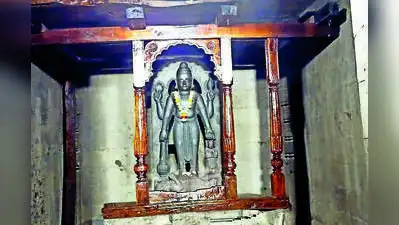
Shri Daityasudan Temple
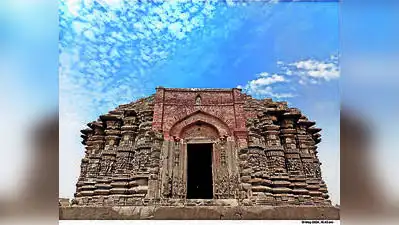
On the entrance step, a faded but readable inscription states: “Shaka 1163, Kanhedev came to the temple. His reign is dated to 1245–1261, and the inscription indicates a visit around 1241. Sachchidanandashram Swami cleared the accumulated soil and revealed the structure.
The outer walls hold an unexpected marker of cross-cultural contact. In the period when Indian kingdoms maintained ties with Iran (Persia), the region’s political and cultural horizons extended beyond the subcontinent. On the western niche of the exterior wall, facing west, is a carving of a Persian Sun God. During Kiranotsav, the sunlight festival, the alignment creates a dramatic effect: the western figure appears to cast light toward the Vishnu shrine, visually linking the Iranian and Yadav–Chalukya worlds through stone and sun. Kanhedev is identified with Krishnadeva Yadav, father of emperor Ramdev Ramchandradev. Records also note that he met Shri Chakradhar Swami at this site, anchoring the temple not only in architectural history but in documented social and spiritual networks. Until around the 1860s, the temple lay buried under a mound of white earth. Through the Nagpur Bhonsles, he facilitated installation of new idols. He later took samadhi here; his memorial shrine stands within the same premises and is still referred to as Swami’s Temple.
The structure measures roughly 25 metres in length and 28 metres in width. The earliest available photograph of the site was taken between 1860 and 1865 by Captain Robert Gill, known for documenting Lonar, Mehkar, and Ajanta. Locals and conservation-minded observers warn that without immediate remedial work, centuries of stone craftsmanship could be lost. You Can Also Check: Gold Rate in Nagpur | Silver Rate in Nagpur | Bank Holidays in Nagpur | Public Holidays in Nagpur | Petrol Price in Nagpur | Diesel Price in Nagpur | CNG Price in Nagpur | LPG Price in Nagpur Stay updated with the latest Nagpur news.
Following sustained efforts by the local group “Mi Lonarkar” with Archaeology Department, safety netting has been installed. Cracks in the roof allow rainwater to seep into the walls, according to Santosh Anand Jadhav of the ‘Mi Lonarkar’ team. Quoting from PK Ghanekar’s book, ‘Vidarbhacha Vigyan Vaibhav Waarsa — Lonar’, Santosh Anand Jadhav of the local group, ‘Mi Lonarkar’, says that the deity is identified with the lotus flowers in both hands, tall boots and a long robe, a style associated with the Iranian Sun cult.
Shri Daityasudan Temple Shri Daityasudan Temple Shri Daityasudan Temple Shri Daityasudan Temple Buldhana : Maharashtra holds architectural treasures that stand in near silence. One of them is Shri Daityasudan Temple in Lonar — a Chalukya-Hemadpanthi marvel built between the 6th and 12th centuries. A striking yet least-visited heritage site, the temple remains unfinished, weathered by time, and still capable of overwhelming visitors with its craftsmanship. The temple lacks a skyline-dominating spire and carries the memory of a hidden original idol, yet holds inverted ceiling stories, a Persian sun facing west, and a seven-layer foundation that testifies to medieval skill. Its core components — the garbhagriha (sanctum) and antarala (vestibule) — remain intact. The sabhamandap/mukhamandapa was left incomplete and later repaired with brickwork, creating a visible contrast with the original stone architecture. Despite this, the surviving stonework is dense with narrative detail: pillars and panels carved with figures and scenes that reward slow, close observation. The presiding deity is Lord Vishnu. The current dark idol appears like black stone but is metal. Local belief holds that the original idol was hidden during foreign invasions and never recovered. The present idol was later commissioned from a senior artist in Nagpur. At Vishnu’s feet is an unusual sculpture of the demon Lavanasur, shown with folded hands seeking liberation, while Vishnu’s foot rests on his navel—an image both rare and theologically charged. The temple stands on a seven-layered jagati (foundation plinth). Each tier is carved with controlled symmetry, suggesting an engineering and aesthetic discipline that still feels difficult to replicate. The carvings include frogs and lotus motifs. Bird expert Jayant Wadatkar has identified a Rohit (flamingo) among the designs. On the southern wall, erotic sculptures add to the temple’s medieval visual vocabulary. The walls are relatively restrained, but the ceiling becomes the true surprise. In the antarala, four triangular corner stones carry inverted carvings with faces turned toward the ground. They are difficult to view unless one stands at a precise angle; even photographs struggle to capture their depth and sharpness. Their elevated placement has helped preserve them. The scenes depict: The slaying of Lavanasura and the descent of Ganga and Bhagirati; Shri Krishna slaying Kansa; The slaying of Hiranyakashipu; Shri Krishna with gopikas and cows. Each carving functions like a compact narrative panel, rendered with finesse despite being positioned where most eyes would never naturally rest. Daityasudan has another enduring mystery: it has no kalash or spire. There is no definitive historical record explaining whether the shikhara was never built, was destroyed, or was removed. The inner portion of the sabhamandap also appears architecturally out of sync with the older core, suggesting alterations during periods of conflict. Yet the temple’s original identity remains unmistakable in its stone vocabulary and compositional balance. His images — available online — show the western doorway blocked with stone and mud, reinforcing how long the temple remained submerged and forgotten. Daityasudan may be quiet, but it is not secure. However, structural threats remain severe. A crack runs from above the sanctum entrance up to the ceiling, accelerating erosion of carvings and weakening the structure. The Persian Sun God statue On the outer wall facing west is a statue of the Persian Sun God. Goa’s New Church museum has a statue identical to the one at Daityasudan temple, explains Jadhav. Download the TOI App.