
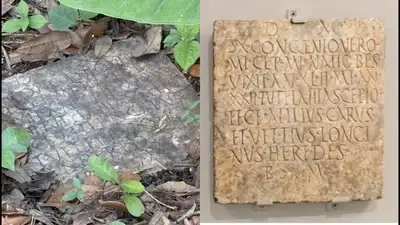
1,900-year-old Roman gravestone discovered in a New Orleans backyard in 2025 has returned to the Italian city of Civitavecchia where it soon be put on public display.
It was first discovered in 1866 near the old Roman port city of Centumcellae, today called Civitavecchia. For decades scholars had thought the ancient monument was lost forever until March 2025 and was then found in the backyard. The gravestone was lost from the collection and the museum was destroyed.
The marble tablet, dating from the second century A.D., commemorates Sextus Congenius Verus, a sailor who served in the Praetorian fleet based at Misenum near Naples, according to the University website. It then passed into the collection of the city’s civic museum. But the story took a turn during the Second World War. The stone was found by anthropologist Daniella Santoro, of Tulane University, and her husband, Aaron Lorenz, as they worked in the backyard of their home in New Orleans.
It will be one of the featured artifacts when the museum reopens September 18 after a massive renovation. The new museum will display archeological artifacts, multimedia presentations and interactive exhibits that illustrate more than 3,000 years of Civitavecchia’s history. An artifact missing since 1943 survived generations intact before turning up thousands of miles away, waiting to be recognized. A Roman sailor’s gravestone has come home, as a reminder that even after almost 2,000 years and decades of being lost, the past can find its way back.
The gravestone is being prepared for public exhibition at the National Archeological Museum of Civitavecchia. The importance of the return of the tablet is not only for its age, but for the return of a key element of the city’s archeological heritage. For Lusnia, the journey is a powerful reminder that history can emerge in the most unexpected of places.