
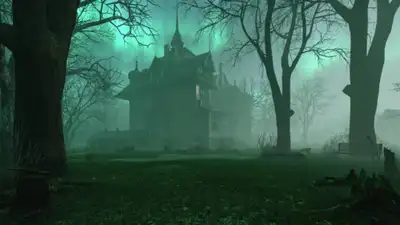
Image credit: iStock
One of the most enduring horror stories links the 1980 Hollywood film The Changeling to a quiet street on the edge of Denver’s Cheesman Park. He settled on a house at 1739 East 13th Avenue, a property that no longer stands. Trouble started on February 9, 1969. Phil Goodstein, in his 1996 book The Ghosts of Denver: Capitol Hill, noted that the historical details in Hunter’s story do not fully line up.
The spirit of the boy spoke through him and revealed a grim history, according to Hunter as mentioned in the Denver Public Library.
Every morning around 6 a.m. the house filled with loud “banging” and “crashing”. That substitution; the “changeling” became the title of the film. Hunter said he received permission to dig and that human remains and a gold medallion inscribed with the boy’s name were found.
The movie The Changeling drew its plot from the unsettling experiences of Russell Hunter, a man who rented an old house there in the late 1960s and came away claiming it was haunted by a child who never found peace. Hunter had worked as a musical arranger for CBS-TV in New York City. In the mid-1960s he moved to Colorado to help his parents run the Three Birches Lodge in Boulder. By the late 1960s he was looking for a place in Denver where he could live and keep composing. The noise stopped the moment Hunter’s feet touched the floor. Soon faucets turned on by themselves. Doors opened and closed without anyone near them. Walls shook hard enough to knock paintings down. What began as odd interruptions quickly felt personal and relentless. Hunter and an architect friend later found a concealed staircase behind a closet. It led to the third floor. The journal belonged to a disabled boy kept in isolation. He wrote about his favorite toy, a red rubber ball. A few nights after the trunk was opened, a red rubber ball dropped from the top of a spiral staircase in the house. The detail felt too specific to ignore. A séance followed. The child had been heir to a fortune from his maternal grandfather. When the boy grew gravely ill, his parents feared the inheritance would pass to another branch of the family. After the child died, they secretly buried him in a field in southeast Denver and adopted a boy from a local orphanage who looked enough like their son to pass. They trained the new child to take the dead boy’s place. The spirit supposedly gave directions to the burial site under a house on South Dahlia Street. Soon after, the activity in his own house turned more violent. Glass doors shattered in his face and cut an artery in his wrist. The inner walls above his bed collapsed inward. Hunter moved out. He returned only once more, to watch the building’s demolition as the site made way for a high-rise. He later claimed that when the walls of the wing containing his old bedroom gave way, they flew outward and crushed the bulldozer operator to death. The remark added a final, grim chapter to his account of the place. Dates, family records, and the precise sequence of events might have gaps. Whether the discrepancies stem from memory, embellishment, or incomplete research remains open. What is clear is that Hunter’s experiences, real or partly imagined, supplied the emotional core of a film that still appears on Halloween watch lists Looking for trusted parenting advice? Follow TOI Parenting Circle on Instagram for expert guidance, relatable stories, and practical tips delivered every day.
There they discovered a child’s trunk holding schoolbooks and a journal from roughly a century earlier.