
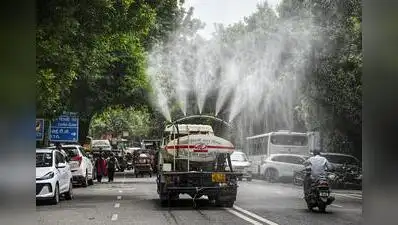
A Municipal Corporation of Delhi (MCD) water tanker sprays water to suppress dust along a road, in New Delhi on Aug 20, 2026
“Adopting low-emission micro-logistics such as GPS-enabled e-fleet for hard-to-reach communities, eliminating long-haul transport and increasing ward-level processing of recyclables and organics to prevent dumping/open burning,” stated the report. New Delhi: Rolling out a digital open burning monitoring system, enforcing protocols to eliminate localised winter trash fires, and procuring low-emission micro-logistics such as a GPS-enabled e-fleet system in hard-to-reach communities were among various strategic options suggested by World Bank experts to MCD for controlling dust pollution in the city. The objective of Saturday’s meeting was to explore sustainable solutions for municipal waste management in Delhi and to study successful waste management practices adopted by leading cities across the world. An MCD team made a detailed presentation on the existing mechanism for collection and transportation of municipal solid waste, including generation from various sources. The experts emphasised identifying MCD’s specific constraints first, such as land scarcity, legacy waste and weak segregation at source, which contaminates recyclables and hampers downstream recycling efforts. They also pointed out the complex urban landscape and hard-to-reach communities, making door-to-door mechanised collection tedious, leading to chronic waste leakage and burning. Experts highlighted “Waste-to-energy (WTE) dependency wherein waste contains a wet fraction makes the WTE not fully adequate as a standalone solution. Also, how waste logistics across the city generate high social, environmental and financial costs to the civic body was discussed in detail at the meeting attended by MCD commissioner Sanjeev Khirwar. Experts proposed approaches to resolve the problem. One example was improving MCD’s operational efficiency through decentralised processing and transport.
The experts suggested adoption of plans based on ground realities: From Tokyo, which uses 23 advanced WTE facilities, to the externalised waste management model of New York City, where private agencies are engaged for transportation and processing of waste, including its movement to facilities outside the city. You Can Also Check: Gold Rate in Delhi | Silver Rate in Delhi | Bank Holidays in Delhi | Public Holidays in Delhi | Delhi AQI | Weather in Delhi | Petrol Price in Delhi | Diesel Price in Delhi | CNG Price in Delhi | LPG Price in Delhi Stay updated with the latest Delhi news. Development of a sustainable waste treatment mix, legacy bio-mining, monitoring of incoming waste calorific value, implementation of advanced flue gas treatment systems and utility tariff (introducing a new pricing structure by a utility organisation where customers pay different rates based on how much they use to fully pay for the daily operational expenses of running the service) rollout to design tiered user fees to cover OPEX were among proposed solutions recommended. Download the TOI App.