
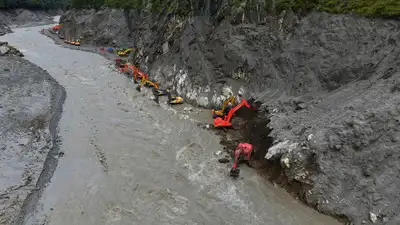
Nepal-China border disaster has killed over 900 people and left thousands missing.
The ice-rock avalanche that triggered Nepal’s devastating August 26 floods moved with extraordinary speed, covering around 22 kilometres to Rasuwagadhi in just over seven minutes, according to a preliminary study by Nepalese scientists. The study, commissioned by the Nepal Environment Society (NES), found that the massive mass of ice, rock and debris began falling from the northern part of the Langtang–Lirung area of Rasuwa at around 8.37 am. Preliminary Nepal Electricity Authority data cited in the study showed that 13 hydropower projects and one solar project were affected, taking around 431 MW of generation capacity out of the system.
Scientists, however, said further field investigation is needed to establish the precise geological mechanism, the contribution of melting ice and whether the river was temporarily blocked upstream. The findings also challenge the initial assumption that the disaster was caused by a glacial lake outburst flood (GLOF). Researchers found no evidence of a GLOF after analysing satellite imagery, hydrological and meteorological data, terrain characteristics and changes in elevation and slope along the river system. There was also no evidence of exceptionally heavy rainfall in the upper watershed on the day of the disaster, weakening the theory that an extreme cloudburst or rainfall event alone caused the floods. The avalanche also caused extensive damage to Nepal’s hydropower infrastructure.
At Rasuwagadhi, the average water level declined between 5 am and 8 am, while flow at Syafrubesi began falling at around 7 am. Earlier reporting noted: The study found that a huge mass of ice, rock and debris fell from around 5,200 metres in the Langtang–Lirung area of Rasuwa and entered the Lhende River. The surge then travelled downstream through the Bhotekoshi and into the Trishuli, generating a powerful debris-laden flood, My Republica reported.
Earlier reporting noted: Nepal floods triggered by ice-rock avalanche: Nepalese scientists Kathmandu, The devastating floods in Nepal that swept through the Bhotekoshi–Trishuli corridor were triggered by a massive ice-rock avalanche in the high Himalayas, not by conventional rainfall, according to a preliminary report by Nepalese scientists.
The study noted another striking feature: water levels and river flow in the Rasuwagadhi and Syafrubesi areas fell several hours before the destructive surge arrived. Earlier reporting noted: The study concluded that the disaster was not caused by a glacial lake outburst flood .
Pingback: Avalanche at Himlung Himal base camp in Nepal leaves 10 missing: The wider industry impact