
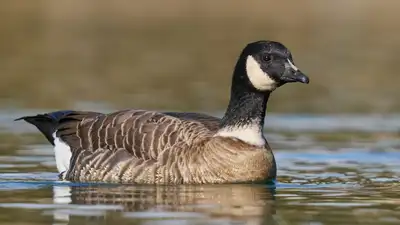
Aleutian cackling geese
In 1962, USFWS biologist Robert Jones found a surviving group of about 300 to 800 birds on Buldir Island. In 1967, the Aleutian cackling goose was given formal protection under the Endangered Species Preservation Act, which came before the modern Endangered Species Act of 1973. Numbers rose from fewer than 1,000 birds in the mid-1970s to several thousand by the late 1980s. In 1975, federal officials completely closed hunting in important California migration areas to remove hunting pressure while the population was still extremely low. In 1987, the USFWS established the San Joaquin River National Wildlife Refuge under the Endangered Species Act and Migratory Bird Conservation Act. More than 500,000 native trees and shrubs, including valley oaks, willows and cottonwoods, were planted across 2,500 acres of river floodplain. By 1990, the USFWS had changed the Aleutian cackling goose’s status from endangered to threatened. Continued population growth eventually led to the species being removed from the Endangered Species Act in 2001, when its numbers passed 30,000. As the population grew beyond 100,000 and moved towards 200,000, the main challenge changed. Federal Register Document 2023-17175, which sets the migratory bird hunting frameworks for the 2023-24 season, confirms that the Aleutian cackling goose is now managed under normal migratory game bird hunting rules in the Pacific Flyway. Its recovery from fewer than 800 birds in 1975 to around 200,000 today is considered one of the most successful bird conservation efforts in North American wildlife management.
The USFWS then began a long-term recovery programme with two main goals: remove introduced foxes from former breeding islands in Alaska and protect important winter feeding and resting areas along the Pacific Flyway. Once the islands were free of the introduced predators, managers released captive-bred geese and moved wild birds from Buldir Island to help rebuild breeding colonies. To balance farming concerns with wildlife protection, federal and state agencies introduced limited late-season hunting and hazing programmes.
By the middle of the 20th century, wildlife experts feared the Aleutian cackling goose had disappeared from most of its historic breeding grounds, which once stretched across the Aleutian Islands, Commander Islands and Kuril Archipelago. The remote volcanic island in the western Aleutians had steep cliffs and harsh conditions that prevented fur traders from bringing Arctic foxes there. The Buldir flock became the only remaining wild population and the main genetic source for later recovery efforts. Removing Arctic foxes from islands including Agattu, Amchitka and Kiska took decades of work by federal wildlife teams. Early attempts faced problems from native predators such as bald eagles. However, improved release methods and the use of both captive-bred and wild birds helped increase survival. With more breeding sites protected, the population slowly began to grow. Protecting breeding areas in Alaska solved only part of the problem. Every autumn, Aleutian cackling geese migrate thousands of miles south along the Pacific Flyway to spend the winter in California’s Great Central Valley. The refuge was created in part to protect winter habitat for the recovering geese. Located where the San Joaquin, Tuolumne and Stanislaus rivers meet, the refuge provided safe places for the birds to rest and find food during the winter. Refuge staff managed crops such as corn and winter wheat, built roosting ponds and carried out large-scale habitat restoration. The work created one of the largest connected riparian woodland restoration projects in California’s Central Valley. Public species information from the San Joaquin River National Wildlife Refuge shows that thousands of Aleutian cackling geese now gather there every winter. The birds use protected wetlands and nearby agricultural fields for feeding and resting from late autumn until early spring before flying north again to their Alaskan breeding grounds. Instead of preventing extinction, wildlife managers had to deal with local problems caused by large numbers of geese, particularly damage to farmland. In spring, migrating geese gather in northern California coastal counties such as Humboldt and Del Norte. They feed heavily on nutrient-rich pastures, and large groups can create financial problems for cattle ranchers and dairy farmers. These efforts are designed to move large flocks away from private farmland and towards managed public areas such as the Humboldt Bay National Wildlife Refuge and Lake Earl Wildlife Area. The rules set limits on hunting seasons, daily bag numbers and specific hunting zones. The aim is to keep hunting at sustainable levels while helping reduce local agricultural damage. The Aleutian cackling goose weighs between four and six pounds. It can be recognised by its relatively small body, dark feathers and a clear white ring around the base of its neck. The USFWS continues to track the population through aerial and ground surveys across Alaska’s breeding areas and California’s wintering grounds. These surveys help officials ensure that controlled hunting and habitat protection keep the population stable across the Pacific Flyway.