

7 reasons why excellence alone won’t move you up
Sylvia Ann Hewlett, an economist whose research on workplace advancement has run in the Harvard Business Review for over a decade, found that employees with a senior sponsor, someone who actively advocates for them in rooms they are not in, are up to 53 per cent more likely to be promoted than those without one.
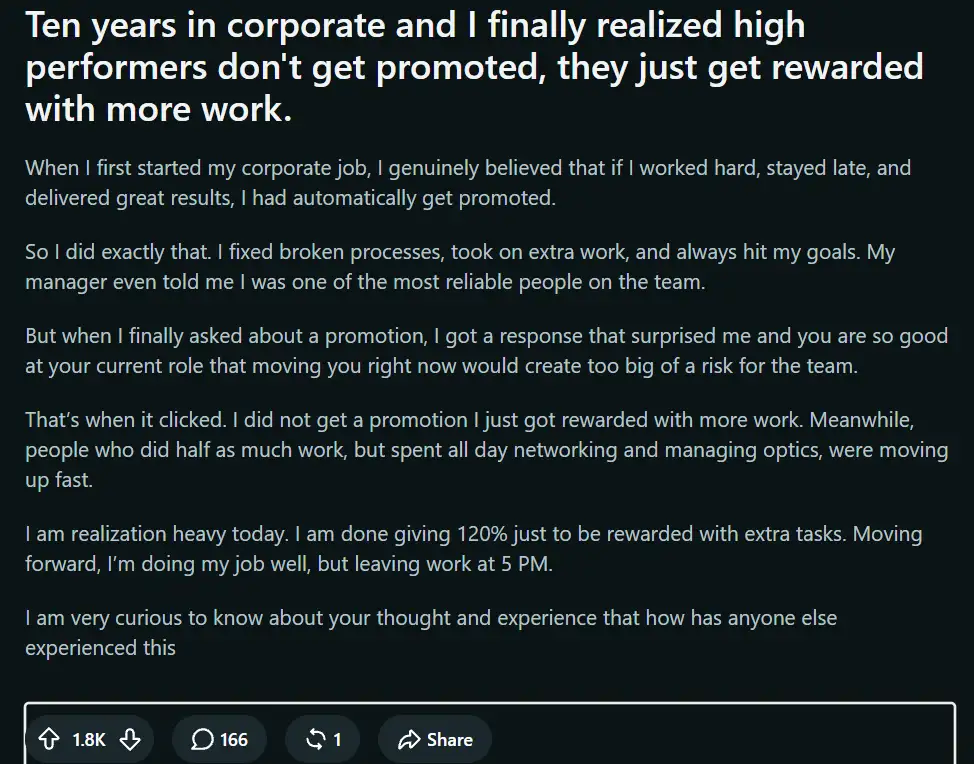
The Reddit poster’s observation that colleagues who “spent all day networking and managing optics” advanced faster is not a complaint about unfairness so much as a description of how promotion decisions are actually made: by committee, based on who a candidate is known and vouched for by, not solely on a spreadsheet of completed tasks. The Reddit poster’s manager gave away the real reason without meaning to: promoting them was framed as a risk to the team. Recruitment firm Antal describes every promotion decision as containing a hidden risk calculation, one that weighs the safety of keeping a proven performer in place against the uncertainty of testing them somewhere new. Organisational researchers call this the indispensability trap, and it tends to be worse for employees with specialised knowledge or deep institutional relationships that would be difficult to hand over. Economists refer to it as a specificity premium: your skills have become so valuable in your current seat that moving you starts to look expensive rather than rewarding, even though the reward was supposedly earned. Diligence gets noticed by a manager. Sponsorship gets you discussed by people who are not your manager.
The employee who decided to stop giving 120 per cent and start leaving at five is not opting out of ambition. Related to sponsorship, but distinct from it, is the simple problem of visibility. Career coaches who study overlooked high performers point out that reliability itself can become invisible once it is expected. An employee who never misses a deadline eventually stops being noticed for not missing deadlines. Without some form of deliberate self advocacy, whether that is documenting wins, speaking up in the right meetings or asking directly for stretch assignments, consistent output tends to fade into the background of what a role is simply assumed to include. None of this means effort is wasted, only that effort was never the whole application. Bertrand Russell, writing decades before anyone had coined the term burnout, argued against what he called the virtuousness of work for its own sake, insisting that a certain amount of leisure was not idleness but a form of civilisation. They are simply refusing to keep paying, in unpaid overtime, for a promotion that reliability alone was never going to buy.