
Kevin Minto, a British metal detectorist and former soldier, was scanning farmland near Ilminster, Somerset, in 2018 when his detector gave him a signal. He dug into the soil expecting something far less remarkable. At first, he thought he had found a coin. Then he wondered if it might be a brooch.
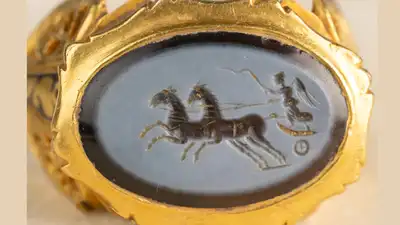
What Minto had pulled from the ground was a 48-gram Roman gold ring, set with a blue gemstone carved with the image of Victoria, the Roman goddess of victory, riding a two-horse chariot. The gemstone was the clue The ring is enormous by Roman jewellery standards, weighing around 48 grams, and is made from gold. The ring wasn’t alone Minto’s discovery was made alongside a hoard of 297 Roman coins. Why had someone buried so much wealth in this particular place nearly 1,700 years ago? The ring dates to around AD 297, a period when Roman Britain was experiencing considerable political and military upheaval.
Because the ring was not simply an attractive piece of jewellery, that image matters.
The Guardian described the discovery as a “spectacular” Roman ring. Minto told the Guardian that his first thought was that it was a coin, followed by the possibility that it was a brooch. The moment was enough to leave him “dumbfounded”, while another detectorist with him reportedly shouted that they were rich.
Minto was not excavating an archaeological site with a team of specialists. Only after examining it more closely did he realise he was looking at a ring. But the real surprise came when experts examined the object. Its most distinctive feature is the gemstone set into its elaborate mount. Carved into the blue stone is Victoria, the winged Roman personification of victory, driving a chariot pulled by two horses. Its size, craftsmanship and symbolism suggest that its owner was someone of considerable status. Experts believe it may have belonged to a wealthy and powerful Roman individual, potentially someone connected to the administration or military establishment in Roman Britain. Its exact owner, however, remains unknown. And there was something else buried nearby. Together, the objects created a much larger archaeological puzzle. Researchers believe the objects may have been deliberately hidden for safekeeping, although there is no way to know precisely why the owner never returned for them. The possibility is tantalising: someone once held a valuable gold ring depicting the goddess of victory, gathered other valuable possessions and placed them underground. Whatever happened to that person, the treasure stayed hidden long enough for the memory of its existence to disappear completely. Looking for trusted parenting advice? Follow TOI Parenting Circle on Instagram for expert guidance, relatable stories, and practical tips delivered every day.
He was a lorry driver and former soldier who enjoyed metal detecting, returning to the Somerset field after previously finding Roman coins there.