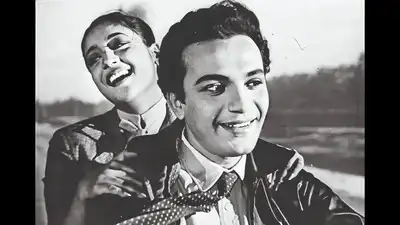
A still from Saptapadi (1961)
Further, there was a clutch of films that he was working on which were completed and released posthumously. This would be hard to explain to millennials who might not be able to wrap their heads around the idea of the privacy actors enjoyed back then. Apocryphal tales of how a barber was used as his double abounded, and the films themselves were blockbusters thanks to the Pakeezah effect, of a film benefitting from the demise of its main star.
Because of the absence of national television and a pan-Indian television diet that ‘awbangalis’ got a glimpse of this superstar’s works, grace, was what made Uttam Kumar special and it is.
It is said that in Shesh Anka , he changed the scripted brutal strangling to an accidental knifing. At 6pm Saturday evenings, all Calcuttans irrespective of whether they were from Allepey, Amritsar, Aizawl or Aurangabad would sit before their EC TVs to watch the feature film in Bangla. This was how a Malayali eight-year-old got acquainted with the premium presence of Uttam Kumar . If the film starred a lesser light, my father would bury himself in The Statesman editorial while my mother would get back to the breathless shenanigans of her Barbara Cartland novel. However, if it was an Uttam starrer, they would put everything aside to watch the Guru’s incredible charisma and his measured performances. A year after I began to watch television, Uttam Kumar died and was bid farewell in a funeral that was mammoth and anguished in equal measure. Yet, Uttam Kumar remained the highlight of Saturday evenings, the man whose films had the oomph very few Bengali films could boast of in his absence. His pairings with Suchitra Sen resulted in classics that continue to be held up as the gold standard of Bengali romance. Finally, it was the choice of roles that made him so synonymous with the golden age of Bengali cinema. He never played the role of a ruffian who reforms, the lumpen who is violent and angry, or anything close to a hoodlum. Even when he played a negative role, Uttam tread carefully. It was a rare blackguard turn by the Mahanayak and he wanted to calibrate how far he would go to with the villainy. Looking back, perhaps the greatest legacy of Uttam Kumar was how he played his age. He was barely fifty when he played a slightly older character opposite the fresh-faced Sumitra Mukherjee in Bikele Bhorer Phool . Similarly in films like Agniswar and Ogo Bodhu Shundori he was shown as an older character, albeit central to the film. That grace cannot be lauded enough at a time when actors in their 60s are still romancing heroines half their age. He and his younger contemporary Soumitra Chatterjee defined a certain era of Bengali cinema when it was just so fine.