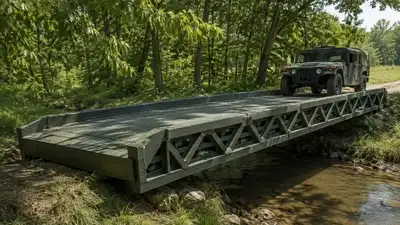
Army light vehicle crossing a 25-foot tactical bridge engineered from recycled thermoplastic lumber at Fort Leonard Wood. Representative Image: An AI-generated conceptual rendering illustrating a U.S. Credits: ChatGPT
The US Army finished an unusual project in June 1998 at Fort Leonard Wood, Missouri, routing around 13,000 pounds of recovered mixed plastic that would have likely ended up in a landfill. The 25-foot-long structure was made across the creek at Gammon Field and was designed to carry loads equivalent to light vehicles. CERL had been developing this idea since the early 1990s with Rutgers University, the US Environmental Protection Agency and plastic lumber manufacturers, according to the Army’s 1998 report. A bridge made out of recycled-plastic lumber for vehicles The finished structure was designed to bear loads equivalent to light vehicles and measured 25 feet long and 26-and-a-half feet wide. A contemporary Army report has given the bridge a safe capacity of 100 pounds per square foot, or more than 30 tons over the entire structure. Though this does not mean that the bridge was intended to carry 30-ton military vehicles; instead, the figure describes the structure’s calculated capacity. Estimates note that treated wooden bridges at the installation lasted around 15 years under local conditions, while untreated structures could require replacement more frequently. Lampo projected that the recycled-plastic bridge could last approximately 50 years with minimal maintenance. Likewise, the Army’s 1998 publication argued that large amounts of plastic were entering the US waste stream and that stable markets for recycled plastic lumber existed. The 1998 bridge used around 13,000 pounds of waste plastic that would otherwise have been destined for landfill. In 2016, Rutgers reported that the bridge Nosker and Lampo built at Fort Leonard Wood 18 years earlier was still holding strong and that Lampo had even visited it.
Because while recycled plastic lumber had already been used in smaller structures, no other known structure in 1998 had demonstrated comparable structural capacity, the Army’s own report considered the project a significant one. Because different polymers and contaminants could complicate separation and reprocessing, why the Army wanted to use mixed plastic Mixed plastic waste was a challenge to recycle through conventional systems. Because if recovered plastic could be engineered into bridge components, the material could potentially enter a market where durability and resistance to moisture, rot and insects were valuable properties, thus, the significance of the structure was larger than the amount of plastic in one bridge.
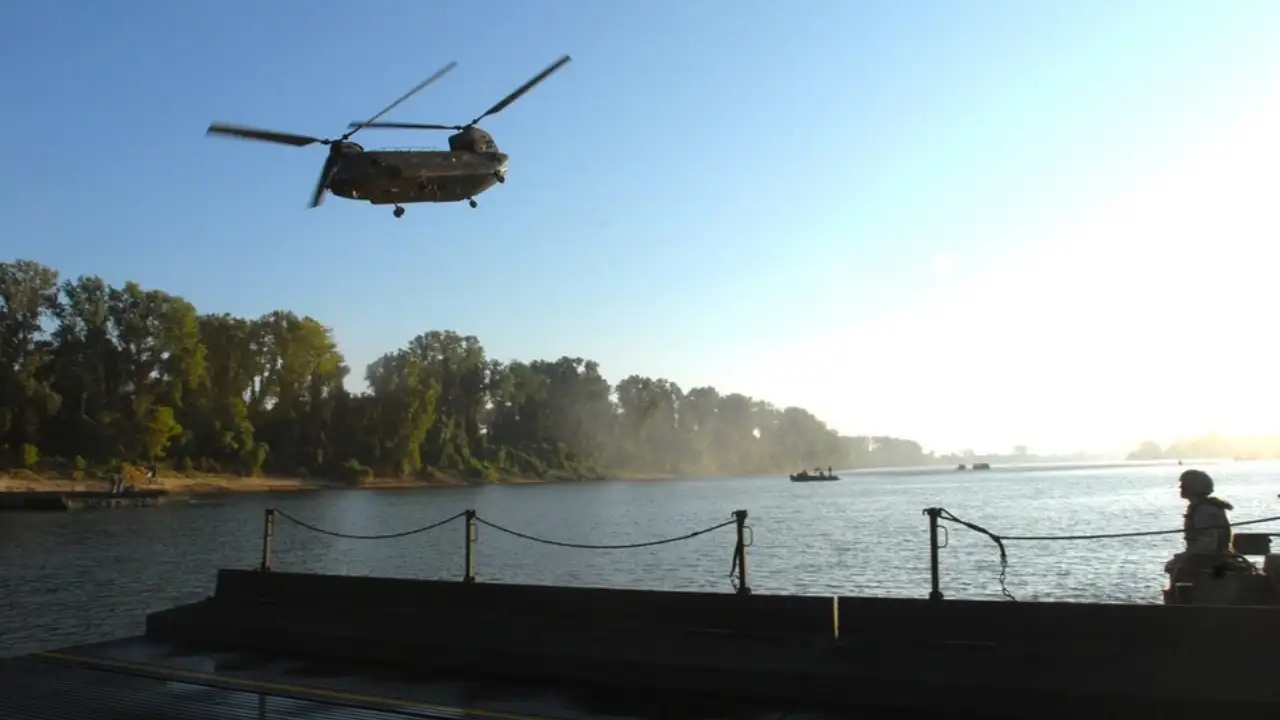
The officials of Fort Leonard Wood reported that a conventional wooden bridge usually required recurring maintenance, including replacement of deteriorated boards and loose fasteners. The US Army Construction Engineering Research Laboratories (CERL), alongside Fort Leonard Wood’s Directorate of Public Works, led this project. Engineers did not build the entire structure out of plastic, though. The recycled-plastic components were installed as the primary spanning superstructure directly onto the six steel beams that had supported the original wooden bridge. Thermoplastic members were reportedly used for the bridge’s joists, decking and railings, while the existing steel I-beams remained in place, as noted by later engineering accounts . Richard Lampo, a researcher at CERL who helped lead the project, had shared that the bridge was made with an intention to push recycled plastic beyond products such as picnic tables and park benches. Transformation from mixed waste to a bridge material The Fort Leonard Wood initiative was based on research that had begun several years prior. The Army wanted to improve the quality of the recycled plastic products and develop standards and specifications for their use. They were also keen to determine whether the technology could be used in military and civil-works construction. Thomas Nosker, a Rutgers professor who was developing structural recycled plastic lumber from mixed post-consumer plastics, had partnered with Lampo to work on potential structural applications. Later records of Rutgers University described the Fort Leonard Wood project as the first structural recycled-plastic lumber bridge for vehicles, thus identifying it as an important early illustration of the technology. The University explained that the material was fundamentally different from ordinary plastic and that this technological process took the raw, unseparated post-consumer stream and processed it into a matrix mainly based on polyethylene reinforced with stiffer plastic or recycled composite materials. The main goal was to develop a material with properties suitable for demanding structural applications instead of simply creating something that looked a lot like wood. The Fort Leonard Wood bridge presented a real-world test of that idea, as the old wooden bridge had reached the point where a replacement was needed. This eventually allowed the researchers to use the site to test out the project they had been working on instead of constructing a completely new installation. The new plastic lumber structure retained the existing steel support beams while replacing the principal wooden bridge components with recycled-plastic materials. Military exercise at Fort Leonard Wood. Image credits: Wikimedia Commons Alongside CERL, the EPA and Fort Leonard Wood’s Directorate of Public Works, the Army’s report has also named Battelle Laboratories and the Plastic Lumber Trade Association as participants, while M.G. McLaren Consulting Engineers designed the bridge structure using a protocol that was developed for recycled plastics. The protocol was made in coordination with the American Society for Testing and Materials and the Plastic Lumber Trade Association. Engineers also tested to see how the structure behaved under load. Reports suggest that the bridge’s deflections and dynamic response were within acceptable limits for the type of structure. On the other hand, durability played another important role in testing the material. However, the Army report noted that the steel support beams could still require repainting, meaning that the expected durability of the plastic components did not make the entire structure maintenance-free. A 1990s Rutgers University paper by Nosker, Lampo and colleagues shed light on the opportunity created by large supplies of inexpensive mixed post-consumer plastics and their alternatives. Rather than replacing the conventional recycling routes for plastic that were challenging to process, this characteristic could complement them. The project so far shows that early experimentation paved the way for later bridges and structural applications. Catch the latest World News and Live updates. Download the TOI app.