
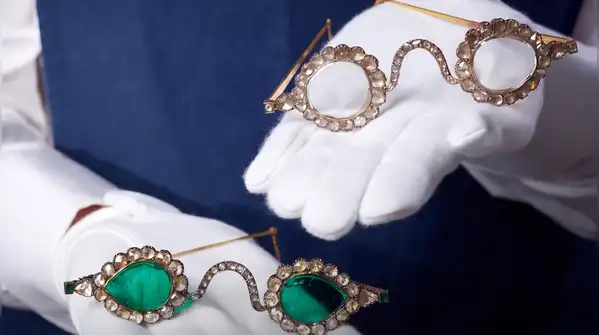
In 2021, two unique antique spectacles appeared in Sotheby’s London auction, making waves in the areas related to jewellery, Mughal art, and gemology. Long before people started showing off diamond-encrusted sunglasses on the red carpet, the concept of making glasses out of real gems existed during the Mughal-ruled period in India.
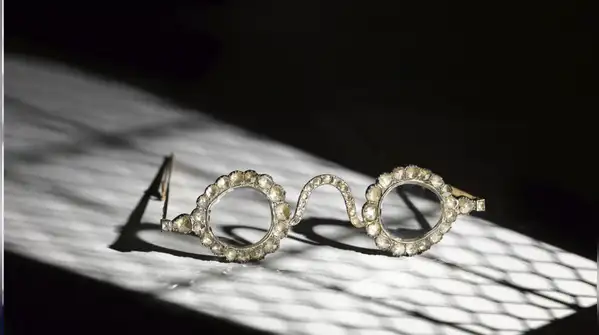
Because they consist of two transparent, almost colourless diamond lenses held in place by a yellow metal frame and encrusted with numerous diamonds, these glasses are commonly referred to as ‘the Halo of Light’. One of them was made with diamond lenses, while the other one was created with emerald gems. These spectacles are believed to be from 17th-century Mughal India, although the frames themselves were found to be constructed in the 19th century. The diamond pair was called ‘Halo of Light,’ and the emerald pair was named ‘Gate of Paradise’. And the figures related to them seem almost unbelievable. The first set, as one can easily guess, is probably the most impressive of the two. But these lenses don’t just have diamonds on them, they are diamonds themselves. The glasses feature transparent lenses that are a natural type of diamond, mostly brought in from the Golconda region. (Image Credits: Pinterest)
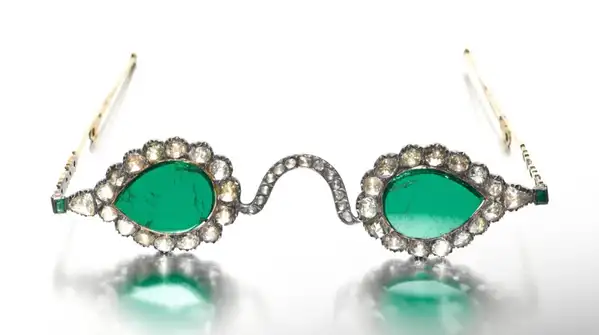
The lenses were cut from a huge emerald that is believed to have weighed over 300 carats before being crafted. However, one does not know the name of the person who gave the nod, idea, and money. (Image Credits: Pinterest) In 2022, the fashion world was once again reminded of these spectacles when Pharrell Williams wore a magnificent pair of diamond-emerald sunglasses during Paris Fashion Week. His sunglasses, customised by Tiffany & Co, consisted of 61 round diamonds weighing over 25 carats in total, along with two emeralds cut in the shape of emeralds. Sotheby’s presented these extraordinarily rare objects at an estimate of roughly Rs 19.16 crore and Rs 31.94 crore, respectively. (Image Credits: Instagram)
These spectacles were commissioned by an unidentified Mughal prince, according to Sotheby’s. This also means that the lenses were not emerald-green lenses, nor were they made of green glass. These were real emeralds, which were cut very thinly to become transparent gems. (Image Credits: Pinterest) Another mystery that comes into play is the identity of the first patron, which remains unknown. The patron’s unknown identity makes the artifacts even more interesting. It is found that they are connected to the Mughal civilisation, and the gemstone lenses were hard to produce. It is recognised that they were associated with a culture in which precious gems had great political, cash, and symbolic importance. Fashion critics took note of the similarities between the modern-day sunglasses and the Mughal spectacles, which opened a discussion on historical reference, cultural appropriation, and whether credit should have been given to the Mughal period.
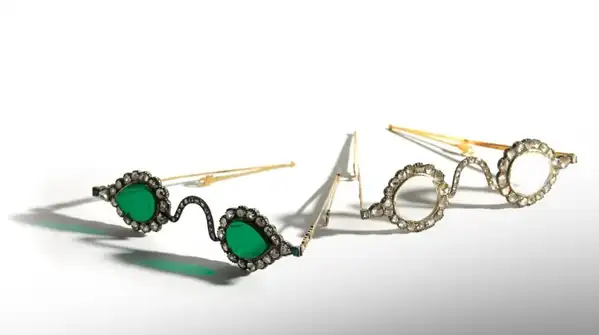

If the diamond eyewear wasn’t extravagant enough, the next designs take extravagance to a whole new level. The eyewear is named the ‘Gate of Paradise’, with lenses made from two transparent, green, pear-shaped emeralds. The lenses are certified to be natural emeralds, made in Colombia, as they share certain characteristics with emeralds from that area.