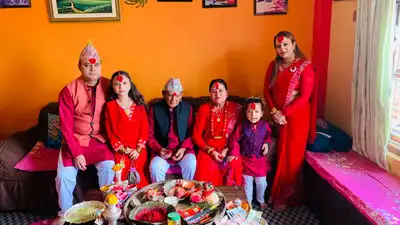
Survivors of the Trishuli flood, including Laxmi’s family, face the daunting task of rebuilding their lives after losing homes, livelihoods and neighbours
At 9.30 am on Aug 26, Laxmi Pandey rushed to the fourth floor of her mint-green family home with her 11-year-old daughter. Now, a little over a week from Aug 26, the 42-year-old and her family — in-laws, husband, son and daughter — are trying to stand up and face their uncertain fate. Laxmi, who ran a liquor shop with her husband, Prakash Pyakurel (44), and father-in-law Chhata Bahadur Pyakurel (69), knows she can never go back to the house. “I used to wake up early, finish the household work and open the shop at 7.30 am. My husband used to reach the shop around 8.30 am. The house was barely 5 minutes away from the shop,” Laxmi said. She paused, as if searching inside her own head a snapshot of herself from 10 days ago. When she moved to Kathmandu on Sept 3 to live in the accommodation of a well-wisher, Laxmi took another family in too. The mint-green house, built 35 years ago by Chhata Bahadur, which became an internet sensation briefly, is now a brick-and-mortar shell.
Because of him, “We are alive. Laxmi Pandey and her family survived the devastating Trishuli flood, but lost their home and livelihood If the Nepal govt allowed and helped, would she go back to the house? Those who survived the flood to tell the tale haven’t just lost material possessions. They have lost an entire community, the very glue that binds all humans together.
Minutes before that, she was about to send little Pradisha off to school, but several people on the road told her that further up, the Trishuli river had flooded its banks and things didn’t look good. “It is hard,” Laxmi confessed, then smiled and said: “Lekin darr ke aagey jeet hai (beyond fear lies victory). “This is the time of the year when people from other places come to take in the beautiful jharnas (waterfalls) that flow into the Trishuli,” Laxmi said. Sab tha wahaan,” Laxmi said. “I can’t go back, and the govt cannot do much either,” Laxmi said. Woh sab beh gaye (they were swept away),” Laxmi said. Sujan Tamang, who lost his house but braved the waters and rescued the Pyakurels, is the “bhai” Laxmi cannot stop talking about. At one point, my daughter was waist-deep in the water on the third storey,” Laxmi said. “Each wave felt like a force that was pushing to topple the house,” she said. My father-in-law said Prayan would be safe as the school is on higher ground. “We can try to live somewhere close to the earlier house, but I just don’t know what will happen,” Laxmi said. My mother-in-law told me ‘in all these years, the river has never breached its banks to enter the shanties. Kuchh nahin hoga (nothing terrible will happen)’,” Laxmi said. “Yes, it felt like that,” Laxmi nodded.
Seven minutes later, the Trishuli roared in and ate up everything. Miraculously, it left Laxmi’s mint-green house standing. The house at Dhunge Bazar, in Nepal’s Nuwakot district, survived the flood like a brick-and-mortar Noah’s Ark, but the lives of the people it sheltered were altered forever. The family will have to restart from scratch. The Trishuli river was the star of Nuwakot. Its water, gurgling down a narrow valley, made for a pretty picture. Chinese tourists from neighbouring Tibet passed through Dhunge Bazar. The place was also a halt for Kailash Mansarovar pilgrims, many of whom were Indian.They all stopped to stare at the river, which was a spot for picnics and pujas. As the town got decent tourist traffic, the Pyakurels’ liquor store too got many kinds of visitors. “I also went to the jharnas whenever I found some free time. The mother of two, who co-ran the family trade and a household, had a busy life. The whole day we managed supplies and interacted with customers. In the afternoon, my father-in-law used to be at the counter. The store, which was the only income stream for the family, vanished into the river before their eyes. Also gone were a car and a scooter. “I had everything. She explained why. “In front of our house was a road. On the other side of the road were shanties. Now, all of that is a river. What can any govt do?” she asked. Going back to the house seems almost impossible for another reason. The raging river, in its wake, left deeper, but invisible, scars on the mind of the community. “The family of seven that lived next door is missing. There was no sorrow or shock in her voice or on her face. Dhunge Bazar, even if it is repopulated, will not be the same town. Laxmi and her family, though, have tried to preserve whatever little is left of the old human bonds in this new, uncertain life. We got a second life. He came that very day and got us out through a window which had broken. The Pyakurel house has four floors, including the ground floor. There is also a small structure on the roof. “When the water entered, it went up three storeys. “With every thud, we thought this would be our last second. This is the end. At that time, all the family members were not at home. Laxmi’s son, six-year-old Prayan Jang, was in school. “I was fretting about what would happen to him in school. But this made Laxmi more worried. “I thought, if the river takes us all, and only my boy survives, what will happen to him? He will be alone. Fortunately, after their rescue, the family and the little boy were reunited. With the clothes they had on their backs, the Pyakurels waded out. A day after, Prakash and Laxmi went back to the house to see if anything could be salvaged. There was little left to take away. So, they too left the town and the river that had nurtured them for decades. In the Indian sub-continent, many rivers, such as the Ganga and Yamuna, are worshipped as mothers. So also the Trishuli. Rivers are where people offer water to their ancestors, do their morning puja, and pray for their loved ones. Rivers are givers for the most part. The people of Nuwakot also knew the Trishuli river as a benign giver. “When the first warning of the flood came, no one believed it. So no one tried to escape. So, when the river took everything, did it feel like the mother was pushing her children away? “But will I fight my mother? No, she is nature. I have to let her be. Catch the latest World News and Live updates. Download the TOI app.