
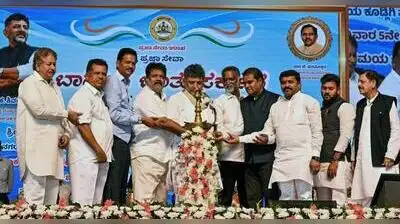
Chief minister DK Shivakumar launches the state-level Prajaseve campaign in Kudligi, Vijayanagara, on Saturday
Under the programme, ministers will lead public outreach efforts at the taluk and hobli levels, while MLAs will oversee activities at the gram panchayat level across all 224 assembly constituencies on the first and third Saturdays of every month. Karnataka has more than 4.5 lakh teachers, he noted, adding that the proposal would be discussed in the cabinet before a final decision is taken. He also said the govt was working on a new reservation model that would provide 15% rural reservation and an additional 7.5% internal reservation to encourage students from govt and rural schools.
Describing himself as a “public servant” rather than a ruler, Shivakumar said the initiative aims to take governance closer to the people and address grievances at the grassroots level. He said that if an MLA is unavailable, govt officials must visit panchayat centres, hold meetings and receive grievances directly from the public. The scheme will succeed only when people receive proper solutions,” Shivakumar said, assuring that the govt would support applicants until their issues are resolved. On education, Shivakumar said the govt was considering using the prefix ‘Tr’ (Teacher) before teachers’ names as a mark of respect.
Applications related to pensions, land disputes, govt benefits, khata transfers, guarantee schemes, housing and site allotments will be examined and resolved. “Receiving an application is not enough. Prajaseve, he added, would serve people irrespective of caste or religion.
Kudligi ( Vijayanagara ): Chief minister DK Shivakumar on Saturday launched the state-level Prajaseve campaign in Kudligi, declaring that the days of people running from one govt office to another to get their work done were over and that the administration would now reach their doorsteps.
Surveys are underway in more than 50 taluks, and based on 21 days of rainfall data and technical parameters prescribed by the Centre, drought-hit taluks would be identified by the end of Sept.
Addressing drought concerns, Shivakumar said a second-stage assessment report was expected soon.