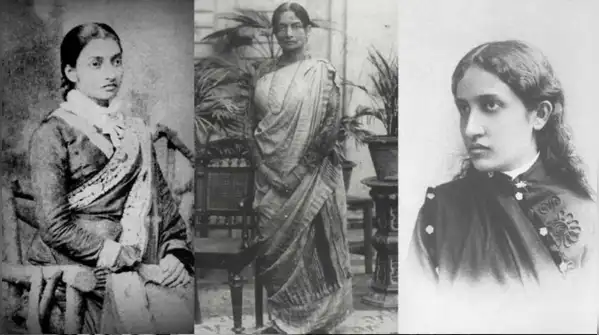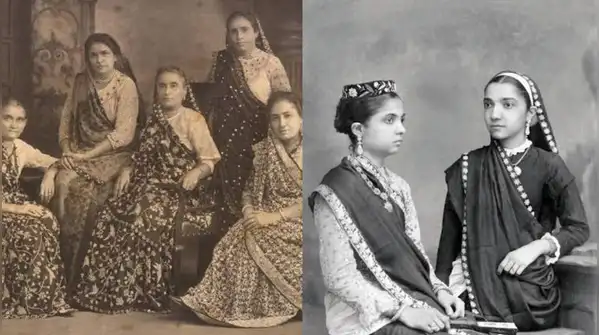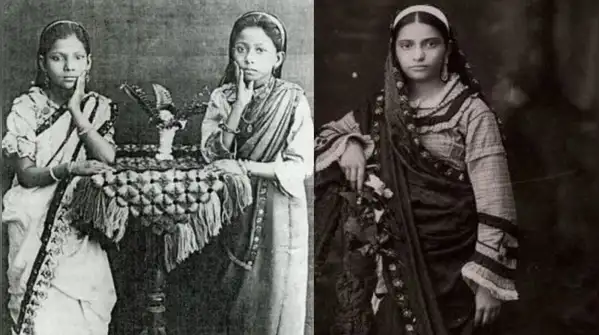
Think about the last time you wore a saree. You probably tucked in the pleats at the front, brought the pallu around, and pinned it neatly over your left shoulder. It feels timeless, doesn’t it? Almost like Indian women have been draping it this exact way for millennia. Well, spoiler alert: they haven’t.
History of the Brahmika drape
She was famously barred from entering a British club because her traditional Bengali aatpoure drape didn’t fit the colonial standard of “proper” public attire, according to historical accounts. By the 1870s, this hybrid style had a name: the “Brahmika” or “Thakurbarir” drape. Think of it as the ultimate “quiet luxury” aesthetic of the 19th century.
The standard saree silhouette we all know and love isn’t actually some ancient, pan-Indian tradition. It is a 19th-century innovation. And the story behind it involves a rigid British club, a prominent Bengali family, and a quiet but massive style exchange with Gujarat. Enter Jnanadanandini Devi. Married into the illustrious Tagore family, she was a woman well ahead of her time. But even her elite status couldn’t prevent a rather humiliating fashion policing incident. Instead of retreating or abandoning her heritage, she decided to reinvent it. When Jnanadanandini relocated to Bombay with her husband, she found her muse. She started noticing how Parsi and Gujarati women draped their yards of fabric. They brought the pallu around the body and tossed it over the shoulder, occasionally securing it with a brooch. It was highly practical. It allowed for easier movement, and crucially, it fit the era’s evolving modesty norms without sacrificing the woven beauty of the garment. She took notes. It was a total game-changer. Suddenly, women had a garment that offered a sharper silhouette and unmatched mobility. It wasn’t flashy, but it was profoundly impactful—a symbol of the ducated, reformist elite stepping confidently into public spaces. It signaled wealth, progressive education, and modern sensibilities, all wrapped up in nine yards of silk or cotton. But fashion is nothing if not cyclical. There is a growing, palpable movement to reclaim pre-colonial, blouse-less, and unstructured regional drapes. We are slowly seeing a shift away from the rigid Brahmika structure, returning to the organic, indigenous roots of the textile to challenge the colonial gaze.
Look closely at today’s runways and the feeds of indie fashion influencers.