
With bold curiosity

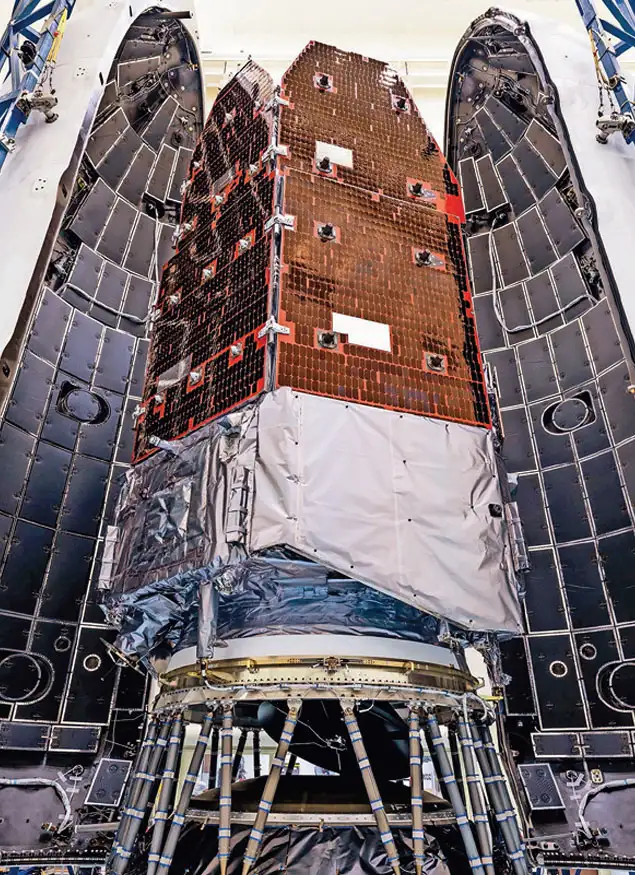
Goodman adds, ‘Around 30 years ago, it was thought the Hubble flow was decelerating and the universe would slow down — then, scientists discovered an acceleration. Because of some hidden gravity, goodman explains, ‘We have evidence for things moving faster than they should,. Goodman explains, ‘This is an ama-zingly capable telescope, built primarily to study dark energy. If you can measure the three-dimensional positions of gala-xies extremely accurately over a huge number, you can test effects in cosmology, see which models are consistent — and whether we even have dark energy or not. What exactly are ‘dark energy’ and ‘dark matter’? Dark matter has gravity, so it has mass. It affects the speed of things in space — but we don’t know what it’s made of. It’s called ‘dark’ as we can’t see it directly. We don’t know if it emits light at any wavelength. There are different theories for what it could be. The generic term for what’s causing that is some kind of dark energy. Different tested theories of dark energy could eventually reflect we don’t understand gravity as well as we think we do. We know what we’re doing on an everyday basis, we send spacecraft to other planets and get them back, but on much larger scales, dark matter and dark energy are key. Our current picture of how the universe was formed, the original Big Bang and what we do see need much bigger scales.’
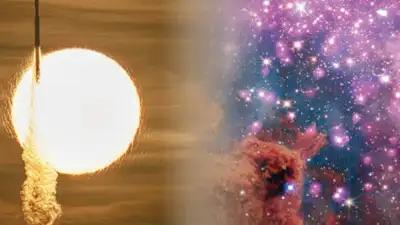
If you slide back and forth between the Hubble and Webb images of it, all kinds of structures get revealed in the infrared which you can’t see in the optical.
She says, ‘I’m interested in the Roman Galactic Plane Survey. Goodman says, ‘There’s a real element of adventure and discovery. It will also enhance Goodman’s own area. This will look at the disk of the Milky Way and help us figure out where all the stars are, what the structure of the Milky Way is and study the dense gas which forms new stars. Goodman adds, ‘These pictures will be the biggest images ever from space which can enhance our understanding of the fabric of the universe and the population of other planets that may or may not be like Earth. ’ Goodman elaborates, ‘The James Webb Space Telescope (JWST) has been incredibly good at that. However, there are many phenomena in the universe that are intrinsically brighter at that wavelength, which our eyes can’t see. Consider the Carina Nebula. What’s blocking out the optical light is dust and gas — the material stars form from. With the infrared, we can study this and look beyond. We can see what’s going on behind it, including the birth of new stars, like the sun. In an era when smartphones inform us about our immediate surroundings, what should keep us intrigued about space? People worldwide appreciate we don’t know everything.There’s so much to be learned. We expect the unexpected — and that’s thrilling.’