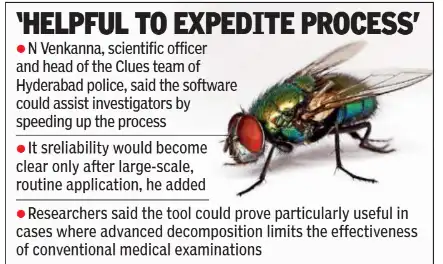
Researchers have developed a digital imaging tool that estimates time since death by analysing photographs of insects found on human remains (File photo)
“With just a click, the accurate time of death of a person can be known,” said Sharmili Nukapeyi, professor at Gayatri College of Engineering for Women, Visakhapatnam, and one of the study’s researchers. The findings, titled “Retrieval of Time of Death Basing on Forensic Entomology through Digital Imaging,” were published recently in the International Journal of Computer Information Systems and Industrial Management Applications. HYDERABAD: A team of researchers from Telangana and Andhra Pradesh has developed a digital imaging tool that can estimate the time since death by analysing photographs of insects found on human remains, potentially offering investigators a faster and cheaper alternative to conventional forensic methods. Traditionally, forensic scientists study insects such as blowflies to estimate the time of death. Flies lay eggs on a body shortly after death, and the resulting larvae, or maggots, grow through predictable stages. By measuring the size and development stage of these insects, forensic experts can estimate how much time has elapsed since death. Since insect development follows a known progression from egg to larva, pupa and adult fly, the program compares the measured dimensions with established growth patterns to estimate the number of days that have passed since death.