
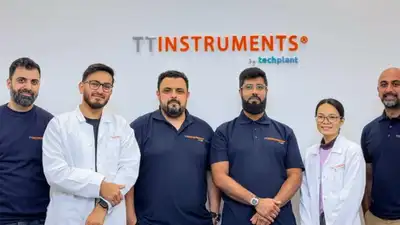
Image: TT Instruments
The company gave high-value equipment a second life
In January 2021, Muhammad Geloo and Aziz Bham launched TT Instruments from the back of a vehicle inspection garage in Blackburn, Lancashire. Five years later, the small start-up had grown into a multi-million-pound business exporting to more than 70 countries across six continents. In 2026, that rapid international growth earned TT Instruments the King’s Award for Enterprise in International Trade. TT Instruments began in January 2021 when Geloo and Bham started selling specialist test and measurement equipment from the back of a vehicle garage in Blackburn. By 2023, TT Instruments had moved into dedicated premises in Blackburn as its inventory expanded. The company says its exports reached more than 70 countries in a single year, with customers spread across six continents. International sales now account for roughly 75-80% of turnover, according to the company’s King’s Award information. The company also achieved ISO 9001:2015 certification, strengthening its quality-management credentials. By its fifth year, TT Instruments had become a multi-million-pound enterprise with consistent year-on-year growth, a striking contrast to the tiny operation that began in a Blackburn garage in 2021.
Because equipment that might otherwise be discarded can continue serving researchers and engineers, the approach has also given the business a circular-economy dimension.
The founders had no external investors, loans or traditional business backing when they began, according to The Lancashire Telegraph reporting on its King’s Award. What began with two founders, a garage and a belief that unwanted technical equipment still had plenty of life left in it has become a remarkable international business story. They had no investors, no loans and no previous experience running a business. Their idea was simple, source high-value precision instruments that companies and laboratories no longer needed, restore them where necessary and give them a second life by selling them to customers who needed specialist equipment. Instead, they saw an opportunity in equipment that large organisations were disposing of despite it still being valuable and functional. Their early operation was small, but the business model allowed them to connect unwanted precision equipment with engineers, researchers, universities and companies looking for specialist technology at lower prices. The founders initially sold equipment online, including through eBay, before rapidly expanding their stock and premises. Within months, the business had outgrown its original set-up and began moving towards a dedicated operation. Rather than manufacturing new instruments, TT Instruments built its business around reuse, refurbishment and resale. The company sources equipment from corporate disposal cycles and other organisations, then tests, restores and supplies it to customers around the world. Its inventory includes sophisticated technology such as Raman spectrometers, fibre-optic analysers, oscilloscopes and other electronic and scientific instruments. One example shared by founder Muhammad Geloo involved a Raman spectrometer restored in Blackburn that was subsequently used by a professor in South Korea for research into macular degeneration. The model allows customers to access specialist equipment while extending the useful life of expensive technology. The transformation from garage operation to international supplier happened remarkably quickly. Its customer base has included universities, small businesses and major technology companies, demonstrating how a specialist supplier from Lancashire managed to reach markets far beyond Britain.