
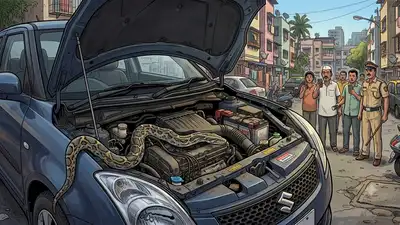
Python found in a car in Dahisar, Mumbai (Image: AI)
A recently driven vehicle can therefore offer residual warmth around the engine compartment. The python was eventually safely removed and released at Sanjay Gandhi National Park, as per reports. Imagine lifting your car’s bonnet expecting to see the usual engine, wires and metal components, and finding a seven-foot python coiled between them instead. That is what happened in Mumbai’s Dahisar, where a python was found hiding inside the engine compartment of a parked car. Residents had reportedly seen the snake moving into the vehicle and alerted the owner, following which a snake rescuer was called. The sight is startling, but the bigger question is surprisingly simple: why would a snake choose a car in the first place? The answer has less to do with cars and more to do with what they accidentally offer wildlife, a dark, sheltered space, protection from the elements and, in some circumstances, warmth or access to prey. Snakes are ectothermic animals, meaning they rely on their surroundings to regulate their body temperature. At other times, the shaded and enclosed spaces underneath a vehicle can provide shelter. There can also be another attraction: food. Cars parked around areas with rodents may become part of a snake’s hunting territory. Rodents can hide around vehicles or in sheltered spaces, potentially attracting snakes looking for prey. This is one reason a vehicle parked near greenery, vacant plots, streams or other areas where wildlife is active can occasionally become an unexpected hiding place. In the Dahisar case, the residential complex was reportedly close to a stream and a natural green patch. Finding a snake in a vehicle is uncommon, but if you regularly park near vegetation or an area where snakes are seen, there are a few places worth visually checking from a safe distance. Engine compartment : This is the most obvious hiding spot and the location. The maze of components beneath the bonnet provides dark, protected spaces where a snake can remain difficult to spot. Under the vehicle : A snake does not necessarily need to climb directly into the engine bay. The underside of a vehicle can provide shelter, particularly when the surroundings are exposed. Wheel wells : The spaces around the wheels can provide another sheltered area and can also offer a route toward other parts of the vehicle. Gaps around the engine and cabin : Modern cars have numerous openings through which wiring, cables and other components pass between the engine compartment and cabin. Damaged or displaced seals can potentially create additional access points. Air-intake and ventilation areas : Less commonly, a snake can potentially access parts of a vehicle through exterior air-intake areas or other openings around the ventilation system. Under seats, floor areas and the boot : If a snake has somehow entered the cabin, dark and relatively undisturbed areas such as beneath seats or inside the boot can provide hiding places.
Because sometimes, the most unexpected thing waiting under your bonnet isn’t a mechanical problem at all. That does not mean drivers need to dismantle their cars before every journey. The risk is generally low. But a vehicle that has been parked for a long time near vegetation, a stream, open land or areas with frequent snake activity deserves a little more attention. This is where curiosity should give way to caution. Do not put your hand into the engine compartment, wheel well or another concealed space to find out where the snake has gone. Do not try to grab it, hit it or deliberately disturb it. If a snake is visible, keep your distance, keep other people away from the vehicle and contact a trained wildlife or snake rescue service. Wildlife rescuers are equipped to identify and safely handle reptiles without putting people or the animal at unnecessary risk. And if you spot one inside the vehicle, do not start driving simply to make it leave. A frightened snake can move unpredictably, while a snake inside the engine compartment can also be injured by moving mechanical components. Probably not. A snake hiding in a vehicle is an unusual encounter, not an everyday risk. But the Dahisar python is a useful reminder that cars are not completely sealed environments from the perspective of wildlife. A vehicle parked near a green patch can look very different to a snake: it may be a dark shelter, a warm surface after a drive or simply another protected space to disappear into. That is why the most useful habit is not fear, but awareness. Before starting a vehicle that has been parked for an extended period particularly in an area with known wildlife activity a quick visual inspection around the bonnet, underside and wheels can be sensible. Looking for trusted parenting advice? Follow TOI Parenting Circle on Instagram for expert guidance, relatable stories, and practical tips delivered every day.