
air pollution
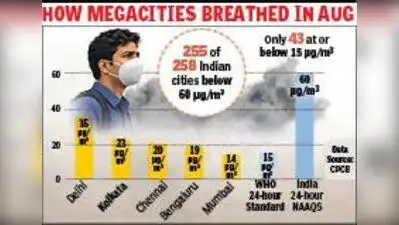
Yet, Kolkata’s Aug average of 23 µg/m³ remained above WHO’s 24-hour PM2.5 guideline of 15 µg/m³, despite favourable monsoon conditions. India’s corresponding 24-hour National Ambient Air Quality Standard is much more relaxed at 60 µg/m³. Because the monsoon usually provides cities with their cleanest air of the year, the figure assumes significance.
Rain removes suspended particulate matter through “wet deposition” while stronger winds and greater atmospheric mixing help disperse accumulated pollution. “Rain droplets capture suspended particles such as PM2.5 and PM10 and carry them to the ground while stronger monsoon winds can also help disperse accumulated pollutants,” said CREA analyst Manoj Kumar. The WHO guideline is a health-based recommendation, not a legally enforceable “permissible limit”.
Kolkata: Even a rain-soaked monsoon could not wash Kolkata’s air clean enough to meet World Health Organization’s benchmark for fine particulate pollution.
As a result, pollution can fall sharply during prolonged spells of rain but rise again during rainless or stagnant periods within the same monsoon month. The persistence of a 23 µg/m³ monthly average in Kolkata during the monsoon, therefore, suggests that local emission sources continue to add a substantial pollution load even when weather conditions favour cleaner air.
Experts said the monsoon’s cleansing effect is neither uniform nor permanent. Rain is also generally more effective at removing particulate matter than many gaseous pollutants.