
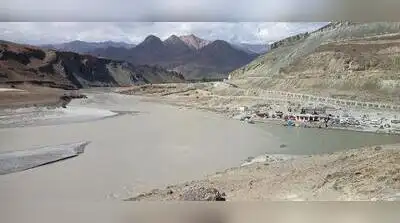
Confluence of Zanskar with the Indus river at Nimmu village
The study found that about 68% of the sulphate in the upper Indus basin is linked to pyrite oxidation. In the mountainous region, this process releases about 4.4 × 10⁵ moles of CO2 per square km every year, while silicate weathering uptakes about 1.4 × 10⁵ units.
The study revealed that the release of CO2 caused by the oxidation (or “rusting”) of pyrite—commonly known as “fool’s gold”—is significantly higher than the amount of CO2 absorbed through the weathering of silicate rocks. “This finding shows that glacier-fed mountain rivers can be important geological sources of CO2,” said co-researcher Gyana Ranjan Tripathy of IISER Pune. Pune : The glaciated upper Indus basin in the northwestern Himalayas releases more carbon dioxide (CO2) than it absorbs, making the rapidly eroding mountain region a net source of the greenhouse gas. This finding comes from a new study conducted by researchers from IISER Pune, Wadia Institute of Himalayan Geology, and IIT Roorkee. This challenges the long-held view that chemical weathering in the Himalayas acts primarily as a natural sink for atmospheric CO2. The study linked the high rates of pyrite oxidation to the region’s unique geology, rapid erosion, and extensive glacial cover. Glaciers and erosion continually expose fresh rock surfaces, allowing pyrite to react more easily with the elements. The researchers noted that these findings are crucial for understanding how the Himalayas have influenced Earth’s climate over geological timescales. They cautioned, however, that while this study covers the northwestern Himalayan region, similar research is needed in other Himalayan river basins, such as the Ganga and Brahmaputra, to provide a more comprehensive global picture.