
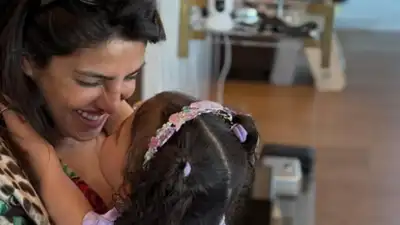
Priyanka Chopra Jonas with daughter Malti Marie (Image: https://www.instagram.com/priyankachopra)
Chopra had described Malti, in an interview as a “foodie” and said her daughter eats the same food as she and Nick Jonas. In several interviews, she has said how strongly she wants her daughter to remain connected to her Indian roots, including through food and culture. Chopra has said that she is “very, very Indian” in her food choices while also recognising that her family is partly American.
A toddler reaching for paneer with her hands, trying foods from different cuisines and happily eating what her parents eat may sound like an ordinary family mealtime. But for Priyanka Chopra Jonas, it has become a glimpse into how her daughter Malti Marie is developing her relationship with food. That included Indian food as well as Korean barbecue, a surprisingly wide flavour map for a young child. The detail is more than a cute celebrity-parenting anecdote: it offers a window into something nutrition researchers have been studying for years, how early experiences with different foods can influence what children are willing to eat later. Chopra has spoken about raising Malti in a household where Indian and American influences naturally come together.
What factors did you consider, or would consider, before choosing the right school for your child?
For parents dealing with a child who pushes away anything unfamiliar, the lesson may be reassuring: liking a new food does not always happen on the first try. That cultural mix is reflected in Malti’s meals. The image is easy to picture: instead of preparing an entirely separate children’s menu, the family is allowing Malti to experience the flavours that are already part of her parents’ world.
Earlier interviews about the toddler described her as a foodie who eats what her parents eat, with Indian food and Korean barbecue among the foods mentioned.
Children often learn through observation. Seeing parents and other family members comfortably eating a particular food can make it seem less unfamiliar. A meal also becomes less about a child being presented with a food they are expected to finish and more about participating in a shared family routine.