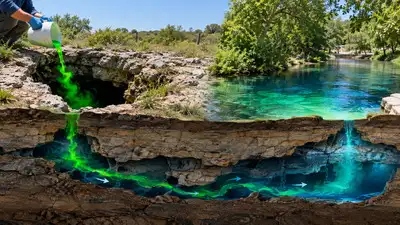
Representative image of fluorescent dye tracing the hidden flow of groundwater through limestone aquifers toward a spring. Image Credits: ChatGPT.
The fluorescein travelled underground and was detected at Barton Springs in under 30 hours. The original tracing report gives the minimum distance to the detection point as about 4.8 miles, while an accompanying account puts it at 4.5 miles. A long-distance groundwater-tracing programme began in 1996 and used injected tracers to map groundwater basins and underground flow paths in the Barton Springs segment of the Edwards Aquifer, according to research published in the Journal of Contemporary Water Research & Education . Results from 40 groundwater traces, 88% of which were successfully recovered, showed that groundwater can move rapidly through the karst aquifer, with mean residence times of about one to eight days.
Because the Edwards Aquifer does not behave like a conventional underground reservoir, where water seeps slowly through tiny spaces between sediment grains, this result mattered. A later synthesis of the tracing work reported that dozens of groundwater traces had been used to delineate flow paths and groundwater basins, with rapid travel times repeatedly observed under suitable conditions. Either way, the experiment demonstrated a rapid connection between Dry Fork Sink and the springs. The study found that tracer pulses travelled through conduit pathways far more rapidly than through the aquifer’s diffuse-flow component, demonstrating how quickly water can move between recharge areas and springs under suitable conditions. Research published in the Journal of Contemporary Water Research & Education also notes that the broader tracing programme demonstrated that rapid groundwater movement is a defining feature of parts of the Barton Springs system. Thus, the Dry Fork Sink experiment made underground flow visible and showed that water entering the sinkhole in the Williamson Creek basin could reach Barton Springs in just a few hours.
The estimated initial velocity exceeded 21,100 feet per day, but that figure should be treated as a minimum estimate rather than the true speed of water through all underground passages. Because they could capture traces of the dye, while water samples provided further readings on the tracer, the activated charcoal receptors proved especially helpful. Dye introduced at one point allows groundwater to carry that information downstream.
The Dry Fork test was one of many in a broader series that began in the mid-1990s to understand how water enters the aquifer and moves underground before reaching springs or other discharge points. Monitoring equipment was installed at the spring sites and other places where the dye could be found. The wider programme eventually identified several groundwater basins within the Barton Springs segment. Traces from parts of the Williamson and Barton Creek watersheds were shown to move toward different discharge points, including Barton Springs and Cold Springs. This replaced assumptions about underground water movement with evidence from water moving through the aquifer. The speed observed at Dry Fork Sink was impressive. Three pounds of fluorescein had to travel at least several miles within less than a day and a quarter. The water does not follow a simple direct path between sink and spring. The experiment also shows why dye tracing is so useful in a karst aquifer. Underground pathways cannot be identified from surface geology alone.