
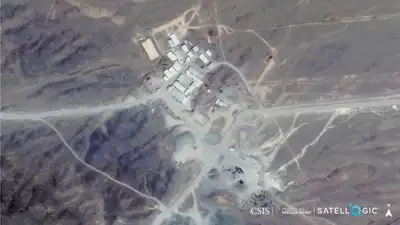
Iran’s suspected Pickaxe Mountain nuclear site sees surge in construction (Picture credit: CSIS & CNN)
The Pickaxe Mountain site, located near Iran’s Natanz nuclear complex about 140 miles south of Tehran, has been the subject of sustained attention from intelligence agencies, which view it as a likely location for protecting future Iranian nuclear programme activities. The document was uploaded to a federal database on February 27, the day before the war began. Satellite imagery showed excavation work beginning between February 16 and February 18 at a remote DTRA and US Strategic Command-operated site at White Sands. The US had previously struck Iranian nuclear sites in June 2025 during Operation Midnight Hammer. Iran said on Wednesday that it had attacked 10 ships near the Strait of Hormuz after the US sank five Iranian oil tankers in the biggest declared wave of tit-for-tat shipping attacks since the six-month-old war began. The escalation sent Brent crude above $100 a barrel for the first time since July, while the average US retail price of diesel rose above $5.94 a gallon.
Because the Pentagon believed its Massive Ordnance Penetrator, or MOP, bunker-busting bombs could not destroy the facility, however, a senior US general told lawmakers last year that the deeply buried Isfahan nuclear site had only its entrances buried.
A suspected Iranian nuclear site buried beneath a granite mountain has seen a sharp increase in construction activity this year as the war between the US and Iran has unfolded, according to a satellite imagery analysis reviewed by CNN. A new analysis by the Center for Strategic and International Studies (CSIS), shared exclusively with CNN ahead of its publication, found “a clear surge in construction activity” at the site in 2026 after reviewing six years of satellite imagery. The CSIS analysts said the underground facility was “likely” designed as a safe haven for Iran’s nuclear programme. Construction at Pickaxe Mountain has shifted from active excavation towards what is probably internal construction and continued reinforcement of the site’s exterior, according to the CSIS analysis. The site has seen “more road activity” in 2026 than ever before, the analysts said. However, the CSIS analysts cautioned that the “continuous construction” observed at the site, among other factors, suggested it was “not yet capable of enrichment work, if that is the intended purpose”. The facility is “likely” designed for one of three purposes linked to Iran’s nuclear programme, according to the analysis. It could serve as a centrifuge assembly facility, an enrichment facility or a safe haven for other “nuclear weapons-relevant” activities such as uranium metal conversion. “We may hit Pickaxe very soon,” Trump told reporters last week, adding that “we know everybody that’s moving” at the site. Trump had also said the US could “hit” Pickaxe Mountain if it detected activity there. The US military maintains operational plans for strikes against Pickaxe Mountain, according to a source familiar with the matter cited by CNN. The strike plan involved some of the largest bombs in the US arsenal, the source said, although it remained unclear whether those weapons could penetrate deeply enough underground to destroy whatever Iran may have moved there. The granite mountain presents a difficult target even for the Pentagon’s “heaviest non-nuclear” bombs, according to the CSIS team. Four days before the US launched Operation Epic Fury, a programme manager at the Defence Threat Reduction Agency signed an emergency $1.2 million contract justification to repair a “unique subterranean test facility at White Sands Missile Range” in New Mexico. The contract was for a “live-fire test designed to validate classified capabilities against rapidly emerging threats”. The memo said the “rapid test prep” needed to be completed within two to three weeks because of a “time-sensitive national security directive”. Three sources familiar with the matter told CNN that the plans were connected to the Iran war and involved developing a way to target Iran’s deepest-buried underground facilities, likely including simulations of US strikes against specific nuclear sites. Iran also said it had fired ballistic missiles at a base used by US forces in Jordan.
The work has included raising and hardening tunnel portal accesses, paving the internal road network, reinforcing areas around the accesses and flattening and removing dirt excavated during tunnel construction. Israeli intelligence has suggested that Iran may be seeking to move centrifuges to Pickaxe Mountain as part of uranium enrichment efforts. US President Donald Trump has repeatedly threatened to strike the heavily fortified site. The US has also been working on ways to target deeply buried underground facilities. The location is intended to test the effects of weapons on deeply buried targets. Work continued into mid-March, when the activity appeared to halt. It could not be independently verified whether the test took place or confirm the purpose of the work observed at the DTRA site. Those strikes destroyed some key locations linked to Iran’s nuclear programme. The US and Iran have exchanged attacks on military, shipping and energy assets since the end of August. The wider conflict has also seen renewed fighting between Saudi Arabia and the Iran-aligned Houthis in Yemen, adding another threat to energy supplies from the Middle East. Catch the latest World News and Live updates. Download the TOI app.
The site was part of a target package considered earlier this summer when Trump was threatening to escalate the conflict with Iran.
A contract to begin developing a prototype was awarded in September 2025, while the Air Force sought defence industry sources for the new weapon in June.
The US military is now working on a “next generation penetrator” bomb intended to succeed the current MOP and potentially reach targets buried even deeper underground. The developments around Pickaxe Mountain come as fighting between the US and Iran has intensified again after a month of relative calm.