
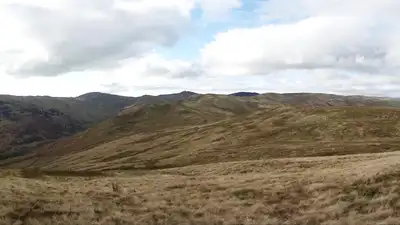
Roundthwaite Common, Tebay
An ambitious upland restoration project in Cumbria has turned a once-bare area of sheep-grazed fell into a thriving habitat, bringing back lost native woodland and attracting 11 new breeding bird species since 2016. The project at Tebay Common began in 2012 through a partnership between local farmers, landowner Lonsdale Estates, and the Woodland Trust. It was supported by a 10-year government agri-environment scheme. By fencing sheep and semi-feral fell ponies out of 26 hectares of the 128-hectare fell, conservationists allowed 60,000 native trees to grow across the landscape. Documents from Forest Research’s national database on natural flood management confirm that the 60,000 trees planted at Tebay Common cover about 12 per cent of the fell. He found that 11 new breeding bird species had moved into the site since the baseline survey in 2016. By 2024, the restored area had 14 breeding species. We are 10 years into what was ecologically very damaged land. The Tebay Common Grazing Association receives £25,600 each year through its environmental agreement to maintain fencing and compensate for lost grazing rights.
This has led to what ecologists call “ghost woodlands”. ” Leeson said planting native trees on a shared common was a major change from traditional land management in the area. “Doing so much tree-planting on a common was groundbreaking,” Leeson said. “Birdsong ripples through the valley as first light spills over a ridge line and on to 26 hectares of fenced-off land near Tebay village,” reported The Guardian during a visit to the site. “I’m surprised by how quickly birds have colonised, and the diversity of species,” Douglas told The Guardian. Douglas said more common woodland birds, including blue tits, great tits, dunnocks and blackbirds, are expected to establish breeding territories as the trees grow and the canopy becomes more developed. Tim Winder, chairman of the Tebay Common Grazing Association, told The Guardian that environmental schemes are becoming increasingly important for upland livestock farmers as agricultural subsidies change. “We have to look at different ways of farming,” Winder said.
Research monitoring by South Lakes Ecology and field data collected for the Woodland Trust found that reducing heavy grazing allowed long-dormant seed banks to recover. “This was a leap in the dark for the farmers, as much as anyone else. Hats off to them. Native species were carefully planted in agreement with local graziers so important livestock gathering routes and open grazing areas could remain. The mix of young trees, shrubs and ungrazed plants has quickly changed the area, especially for bird populations. “Meadow pipits, reed buntings and stonechats are among the choristers. Ecologist Mike Douglas from South Lakes Ecology has carried out yearly bird surveys across the fenced areas. “We’ve been conditioned to see the uplands as barren for much of the year. It needn’t be that way. The Tebay Common project has also become an example of how restoration can support natural flood management and rural incomes. A study on nature-based flood solutions by researchers at Lancaster University found that the project combines tree planting with peatland drain blocking and leaky wooden dams. These measures help store more water, improve soil absorption and slow the flow of stormwater into downstream rivers. The financial support behind the project has also helped local hill farming remain viable. The money is shared between the landowner and participating farmers. “We’ll invite anyone to work with us. Reports from the Woodland Trust’s State of the UK’s Woods and Trees publication say that combining targeted woodland creation with existing grazing rights could provide a model for restoring other upland commons across Britain.