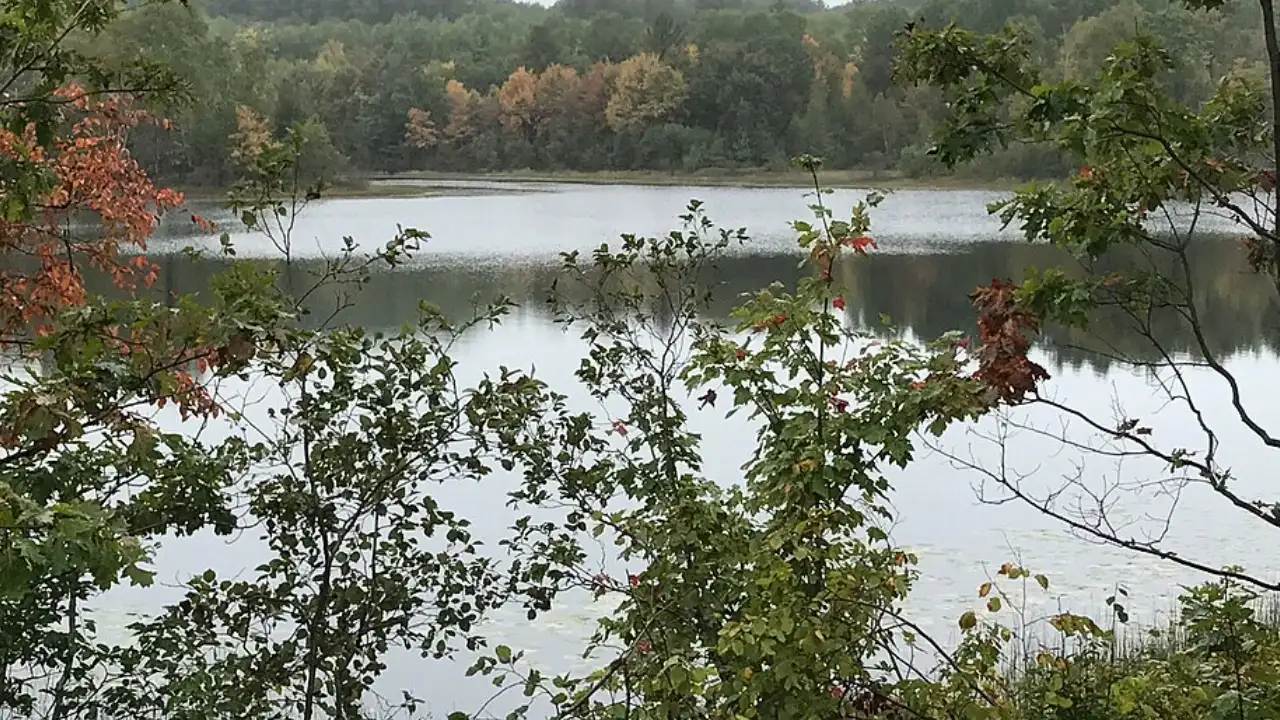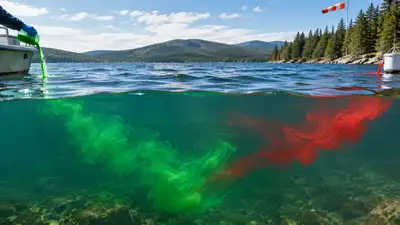
Representative image of colored dye tracers spreading through a lake during a scientific water circulation study. Image Credits: ChatGPT.
Scientists got a rare glimpse of that hidden movement in August 1988, when they released green and red dyes into Twin West Lake in British Columbia. Researchers carried out dye-release experiments in Twin West Lake on August 2, 18 and 24, 1988, according to a study published in Limnology and Oceanography . Typically, researchers slowly poured about two litres of a 20% dye solution into the water. Fourteen marker buoys arranged on a 60-metre grid provided fixed reference points, allowing researchers to reconstruct how the coloured patches changed position over time. The August 24 experiment provided the clearest example. At the surface, the plume travelled in the direction of the wind at an average speed of about 2.8 cm per second. Lower in the epilimnion, however, the water carried the dye in the opposite direction at roughly 1 cm per second. Researchers using Rhodamine WT in a stratified lake found that boundary mixing produced a distinct dye intrusion that travelled more than 200 metres offshore, according to a study published in Water Resources Research .
The observations therefore showed not only where the dye travelled, but also how its movement varied within the stratified upper layer. Sodium fluorescein, which appeared green, was released near the centre of the lake, while Rhodamine WT, which appeared red, was released from the shoreline. Limnology and Oceanography reported that the central green dye responded to the wind-driven circulation, but its movement differed with depth. This contrast revealed that the wind was not simply pushing the entire upper layer forward.
A lake can look still while water below the surface moves in different directions. The experiment showed that wind across the surface did not simply push the whole lake in one direction. Instead, it helped create a layered circulation, with the central dye moving one way near the surface and being carried back in the opposite direction lower down. The concentrated dye solution was initially slightly denser than the surrounding lake water, causing it to sink. As it mixed with the surrounding water, however, it became diluted. The thermocline limited its downward movement, keeping the dye concentrated in the lake’s upper layer. The experiment was designed to show how substances spread through a small lake. To capture those movements, researchers photographed and videotaped the spreading dye from a vantage point overlooking the lake. A camera recorded images every two minutes, while instruments at the centre of the lake simultaneously measured wind speed and direction. Instead, it was associated with a circulation in which water moved back beneath the surface flow. As the wind changed direction, the dye cloud stretched and distorted, further exposing differences between surface and deeper currents. The researchers concluded that horizontal spreading was influenced by vertical differences in water velocity, changes in wind direction and turbulent mixing. The coloured patches were more than a visual demonstration. By processing the video images, researchers could track how the dye clouds expanded over time and use that information to estimate the lake’s horizontal dispersion rate. Similar tracer experiments have shown why such measurements matter. They also recorded elevated eddy diffusivity near the lake boundary, showing how circulation and mixing can influence the transport and spreading of dissolved material in stratified water.
Because substances introduced into a lake do not always stay where they were first released, this matters. Nutrients, pollutants, and other dissolved substances may get transported by currents before they are eventually distributed over a larger area as a result of turbulence. That is why it is important to understand how quickly and in what direction material moves for uses such as lake fertilisation and pollution control.