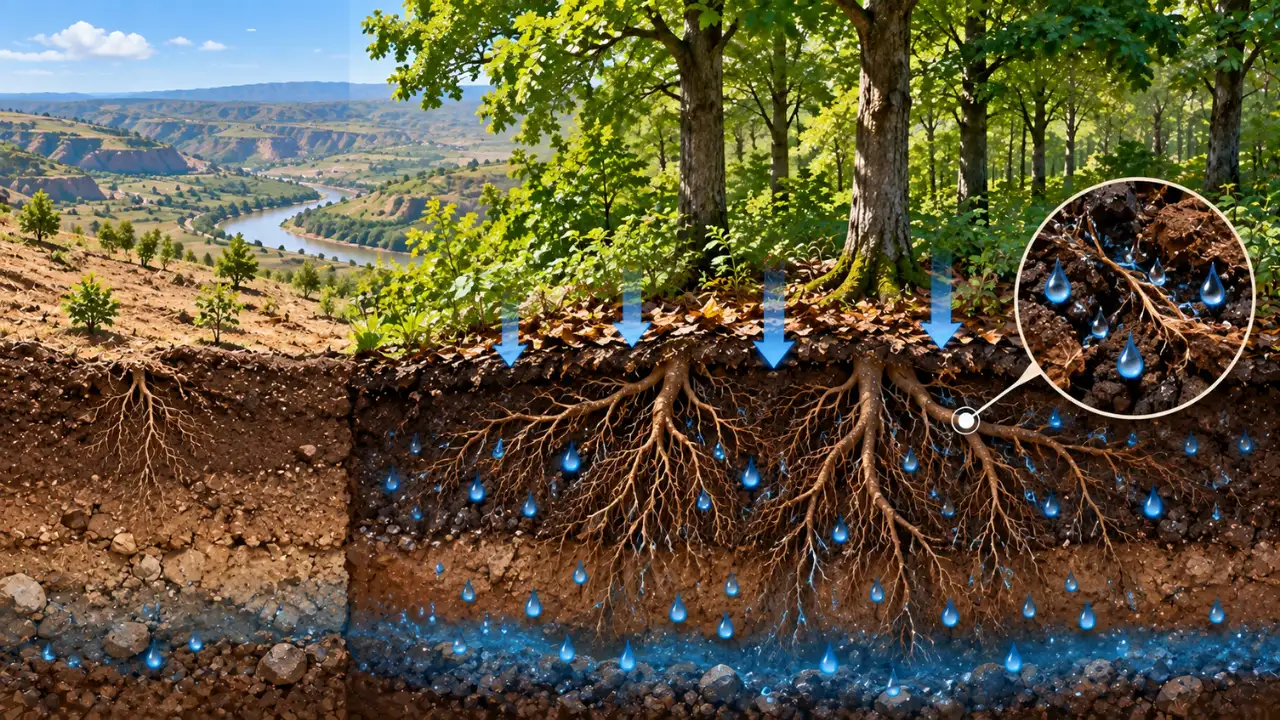
Image AI generated
Researchers spent 18 years monitoring four forest types in the region, comparing plantations of Pinus tabuliformis, Platycladus orientalis and Robinia pseudoacacia with a natural secondary forest. The results showed that the natural forest had 8% higher soil moisture than the planted forests, while recording greater macroporosity and stronger water movement through the soil. Its soil held more water after rainfall, with average soil water storage reaching around 6 mm, compared with 3–4 mm in the planted forests. Over the 2006–2024 monitoring period, the natural forest consistently maintained higher soil water content, while Robinia pseudoacacia and Platycladus orientalis showed declining moisture trends. Titled ‘Natural Forests Accelerate Soil Hydrological Processes and Enhance Water-Holding Capacities Compared to Planted Forests After Long-Term Restoration ’, natural secondary forests had 8% higher soil moisture than the planted forests, according to the study published in Water Resources Research. They also had 68.7% greater macroporosity, a 13.7% larger mean equivalent pore diameter and 34.2% higher saturated hydraulic conductivity.
China’s long-running effort to restore the degraded Loess Plateau has revealed a difference between forests planted by people and those allowed to regenerate naturally. The researchers also found that natural forest soils had lower bulk density and higher levels of soil organic carbon and total nitrogen.
The difference was also visible across the 18-year monitoring period. Natural secondary forests consistently maintained higher soil water content, with peak values reaching 0.28 cm³ per cm³, particularly after substantial rainfall. Pinus tabuliformis showed a slight increase in soil moisture over the period, reaching 0.24 cm³ per cm³, while Robinia pseudoacacia and Platycladus orientalis showed declining soil moisture trends, with average values between 0.15 and 0.22 cm³ per cm³. Their mean macroporosity was 0.113 mm³ per mm³, compared with 0.089 for Robinia pseudoacacia, 0.065 for Platycladus orientalis and 0.047 for Pinus tabuliformis. Average soil water storage was around 6 mm in the secondary forests, compared with 3–4 mm in the planted forests. In the upper 60 cm of soil, moisture fell. The secondary forest maintained higher and more stable moisture, particularly in the upper 60 cm. The researchers also found that the secondary forest had lower bulk density, at about 1.0 g per cm³, in the three planted forests.
The researchers also recorded higher soil organic carbon, field capacity and available water content in the natural forests. The researchers found clear differences in soil structure between the forests. Natural secondary forest soils had the highest macroporosity and better-connected pores. The natural forests also showed faster soil-water processes during rainfall. The researchers linked this greater storage to the natural forests’ higher macroporosity and pore connectivity, which allowed rainfall to be redistributed and infiltrate the soil more efficiently. Image AI generated Soil moisture in Pinus tabuliformis and Robinia pseudoacacia dropped substantially during the driest period from June to August. Platycladus orientalis retained more water in deeper layers, but moisture still declined in the upper soil. Its soils also contained generally higher levels of total nitrogen and soil organic carbon. The study’s analysis identified soil properties such as bulk density and organic carbon, together with understory plant diversity, as important factors associated with soil hydrological processes and water-holding capacity. Catch the latest World News and Live updates. Download the TOI app.