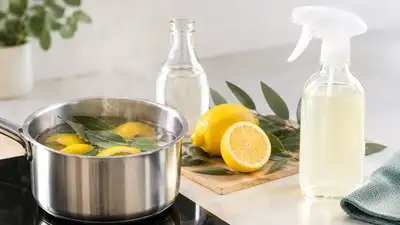
AI Representation: Lemon peels, eucalyptus leaves and vinegar are simmered together to make a naturally scented household cleaner for tackling light grease. Image credits: Chatgpt
Eucalyptus leaves contain an essential oil whose main constituent is 1,8‑cineole (also called eucalyptol), a compound responsible for the oil’s strong, characteristic scent that can help mask the odor of vinegar. It is a weak acetic acid solution, typically about 4% to 7%. The 2022 article ‘The Efficacy of Common Household Cleaning Agents for SARS-CoV-2 Infection Control, ‘ published in Viruses by researchers at the University of Melbourne, compared the efficacy of household vinegar, acetic acid, bleach, dish soap and ethanol against SARS-CoV-2, at contact times approximating a quick wipe (30 seconds) and a brief soak (5 minutes). The results showed that neither vinegar nor acetic acid inactivated SARS-CoV-2 at either the 30-second or 5-minute contact time, even at the highest concentration tested, a 90% v/v exposure equal to a final concentration of about 3.6% acetic acid. The study’s authors reported that household vinegar showed no virus-inactivating effect even at the highest concentration tested, while ethanol inactivated the virus at dilutions as low as 40% and dishwashing detergent was effective when diluted to 1%.
Because it dissolves oils and waxes and is less toxic than many petroleum-based solvents, d-limonene is used as an industrial solvent.
What is actually happening when you heat these ingredients The lemon peel contains d-limonene, a terpene compound also found in the rinds of oranges and limes, according to peer-reviewed research on PubMed Central mentioned in the National Library of Medicine . However, having “some” level of antimicrobial properties against certain pathogens in laboratory conditions is far removed from meeting the criteria to be considered a disinfectant. Simmering lemon peels, eucalyptus leaves and white vinegar on the stove is a homemade cleaning method many people use to freshen a kitchen. The mixture smells sharp and fresh, cuts through kitchen grease reasonably well and costs almost nothing to make. What it does not do is kill the bacteria and viruses that people usually associate with the word “disinfect. Heating may make the mixture seem more effective on light dirt and grime, but the main cleaning action comes from limonene’s solvent properties and acetic acid’s acidity, not the heat itself. The misconception comes from the fact that vinegar and citrus oils can show some antimicrobial activity in laboratory conditions. At the same time, bleach, dish soap, and ethanol demonstrated much better performance. Eucalyptus oil is another example where the statement has been grossly exaggerated, and the presumption here is that since something is ‘natural,’ then it must be a disinfectant by default. An in vitro study titled ‘Antimicrobial Activity of Selected Essential Oils against Selected Pathogenic Bacteria: In Vitro Study,’ published in the journal Antibiotics by Nikola Puvača and colleagues, tested tea tree, rosemary, eucalyptus and lavender oils against four pathogens, including E. coli and Staphylococcus aureus, and compared inhibition zones and minimum inhibitory concentrations. Tea tree oil proved to be the best in comparison, while eucalyptus oil displayed restricted antibacterial activity only.