
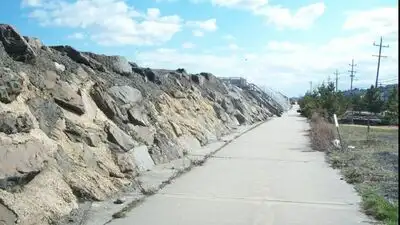
New Jersey built a massive seawall
Over several decades of continuous wave impacts, the elevation of the seabed in front of the seawall dropped significantly. The USGS study documents how the natural movement of sand along the barrier island was interrupted, stripping away the upper foreshore. Eventually, the entire visible beach disappeared under high water levels, leaving ocean waves to break directly against the vertical stone and concrete barrier. Researchers at the USGS pointed out that hard engineering structures inherently change the dynamic equilibrium of coastal systems. By locking the shoreline into a rigid position, the seawall prevented the natural landward migration of the barrier island, a process that normally allows beaches to retreat and rebuild during periods of rising sea levels. Without room to migrate backward or sand to replenish the surf zone, the beach was systematically scoured away until only the wall remained.
Because the underlying seawall continues to reflect wave energy during storms, the dredged sand is continuously pushed offshore, requiring regular re-application at significant taxpayer expense. To restore the eroded shoreline, federal agencies including the US Army Corps of Engineers eventually launched massive sand pumping operations along the Monmouth County coast. The loss of the beach in Sea Bright and surrounding boroughs presented fresh economic and infrastructural challenges for coastal managers. the disappearance of the sandy beach eliminated the first line of defence against storm surges While the highway and residential communities behind the wall remained structurally intact during routine weather. In natural coastal ecosystems, wide beaches and sand dunes act as shock absorbers, absorbing the force of crashing waves before they strike inland structures. Once the beach eroded down to bedrock or deep water, larger waves were able to strike the seawall with full force, increasing the risk of structural failure during major Atlantic storms. Furthermore, the loss of recreational beach access damaged local tourism, forcing state and federal agencies to intervene with expensive artificial replenishment projects. Dredging ships harvested millions of cubic metres of sediment from offshore shoals and piped the slurry onto the bare ocean floor in front of the seawall. USGS scientific assessments caution that such engineering interventions require perpetual maintenance Although beach nourishment temporarily re-established a sandy shore. The USGS report Coasts in Crisis concludes that while engineered barriers can successfully protect high-value infrastructure built close to the water’s edge, they frequently sacrifice the natural beach environment in the process, turning dynamic natural coastlines into permanent concrete embankments.