
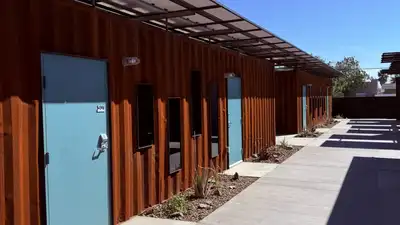
The city of Phoenix has decided to tackle homelessness with a new method. What was once designed to carry goods across oceans is now serving a very different purpose in Phoenix, Arizona: giving older people experiencing homelessness a private place to sleep, shower and begin rebuilding their lives.
On Wednesday, city officials gathered for the opening of Senior Bridge, which provides 40 individual transitional housing units for adults aged 55 and older who are experiencing homelessness and need light-touch support as they work toward permanent housing. Each unit measures just 160 square feet, but it is designed to function as a self-contained living space. The City of Phoenix contributed $750,000 toward the 40-unit first phase. It is also investing another $9.6 million in the project’s second phase, which is planned to provide 56 affordable housing units. Mercy House officials told Axios that there is no fixed maximum length of stay, but residents are ideally expected to move on to permanent housing within about 90 days. Senior Bridge specifically targets adults 55 and older who need a safe and stable place while they work toward permanent accommodation.
Because the project is designed as a bridge rather than simply a place to sleep, those services are important. The city recently opened a new project offering a transitional housing community made from shipping containers for older adults facing homelessness. It is located at 28th and Van Buren streets. The collaboration is between the City of Phoenix and the Arizona Department of Housing and is operated by Mercy House. Residents have a bed, sink, toilet, shower, microwave and small refrigerator. The project is operated by Mercy House in partnership with the City of Phoenix and the Arizona Department of Housing. At first glance, the Senior Bridge units look more like an industrial experiment than conventional housing. The containers have been modified into compact private rooms, with basic amenities built into the limited space. Unlike a traditional emergency shelter, however, residents have their own individual units and private bathrooms. Each resident is paired with a case manager who can help connect them with healthcare, nutrition assistance and community services. People experiencing homelessness are not a single group, and older adults can face particular challenges when trying to move from the street or a shelter into stable housing. The city describes the development as transitional housing for people who need relatively light support rather than intensive residential care. The idea is to give residents enough stability to address the barriers that may have contributed to their homelessness while simultaneously working toward their next housing option.
The 40 shipping-container units are only the first stage of the Senior Bridge project. The second phase is planned to add 56 permanent supportive apartments, significantly larger than the temporary units. The apartments are expected to be around 750 square feet each, according to Axios, and residents will pay affordable rent while not having to pay power bills.
The site can operate completely off the electrical grid, according to Mercy House chief program officer Timothy Huynh. The entire complex is designed to run on solar power, with lithium battery storage. That feature could be particularly relevant in Phoenix, where extremely hot summers can place enormous demands on electricity infrastructure. The solar-and-battery system also gives the development an element of resilience while reducing its dependence on conventional grid power. Construction of the container-based apartments was underway, with residents expected to begin moving in around early December.