
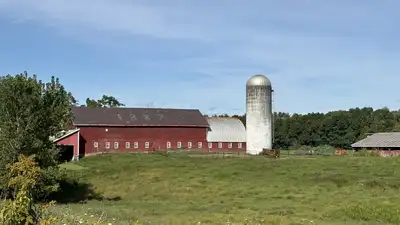
The Butler Family Farm covers about 250 acres (Image Credit: Aaron Shellow-Lavine/ WAMC)
When Don Butler moved to his family’s farm in Northumberland, New York, at age 7, the property’s large red barn, marked with 1887 on its slate roof, was still the primary barn. 75 acres of the Butler Family Farm have now been placed under a conservation easement with Saratoga PLAN, permanently protecting the land for agricultural use, according to a report by WAMC Northeast Public Radio. The Butler Family Farm covers about 250 acres, but its agricultural operation looks very different from when Butler was growing up there. The farm was once a milking operation with around 60 dairy cattle. The family’s decision to protect 75 acres comes as development pressure continues to grow in Saratoga County. The county’s population increased by 6.7% between 2015 and 2025, according to US Census Bureau. Saratoga PLAN, the nonprofit involved in the agreement, has conserved more than 14,000 acres overall. With the Butler family’s property, it says more than 540 acres have now been protected in Northumberland. In this case, the arrangement protects the 75 acres as farmland rather than allowing the property to be converted to another use.
Because it has substantial road frontage, including access along Stonebridge Road and another public road, the 75-acre section is particularly attractive from a development perspective. Because farmers are competing with buyers who have other plans for the property, that can matter in areas where agricultural land is expensive.
Butler and his family members told WAMC about the farm’s history, the changes they have witnessed and why preserving the property has become increasingly important. Butler told WAMC that farming remains common in the area stretching from Gansevoort through Moreau, Northumberland and into Saratoga. What has changed, he said, is the number and size of farms. He told WAMC that he does not believe productive farmland should be used for solar installations. She told WAMC that conservation easements can help make farmland more affordable for farmers by reducing the value associated with its development potential.
Decades later, much has changed around the farm, from the decline of smaller dairy operations to growing pressure from development and solar projects. Smaller operations have increasingly been consolidated into larger ones. That shift has made it more difficult for smaller farms to remain viable, even though agriculture continues to be an important part of the landscape. For Butler, protecting the land is also connected to the growing interest in using farmland for other purposes. As he explained to WAMC, the family receives nearly weekly solicitations for solar farms, along with occasional approaches related to development. Butler has made his position on the issue clear. The conservation easement provides a way to keep the protected portion of the property in agricultural use while removing the possibility of future development on those acres. A conservation easement allows land to remain privately owned while placing permanent restrictions on certain future uses. For Butler’s daughter, Holly Rippon-Butler, the arrangement also has significance beyond her own family’s property. Rippon-Butler is the farm’s third-generation caretaker and works as an independent consultant with organisations that help farmers succeed and gain access to land. As Rippon-Butler explained to WAMC, there can be a significant gap between what a farm business can generate and the amount of money required to purchase farmland near markets, with good soils and the infrastructure needed for agriculture. Removing development potential can help bring the price of land closer to what its agricultural use can support.
Today, the family has three beef heifers, while the property primarily produces dry hay for nearby cattle farms.
The now-protected land was considered as a possible location for a municipal dump in 1998, the same year Rippon-Butler was born. The 1887 barn that Butler remembers from childhood remains a marker of the farm’s long history. 75 acres now have a permanently protected agricultural future, even as development and solar-farm proposals continue to reach farms across the growing Saratoga County region While the operation itself has evolved from a 60-cow dairy to a smaller farm producing hay and raising a few beef cattle.
Gwenne Rippon said she had watched Don Butler’s parents make sacrifices to keep the farm operating and wanted to do what she could to ensure the land remained in farming, according to WAMC. The conservation agreement now gives that goal a permanent framework. The Butler family’s decision reflects a wider challenge for agricultural communities located near growing population centres. As housing, commercial projects and renewable-energy proposals compete for land, working farms can face pressure from uses that may generate more value than agriculture alone. The conservation easement does not transfer the farm to public ownership. Instead, the family retains the land while limiting its future development potential. For Butler, that means the protected acreage can continue to form part of the family farm rather than becoming a subdivision or another non-agricultural project. For Rippon-Butler, it also demonstrates how conservation tools can potentially help younger farmers access land without having to compete with buyers interested in its development value. And for Rippon, it represents the outcome of a family effort to keep the property in farming. Catch the latest World News and Live updates. Download the TOI app.
The decision to protect the property also carries a history that stretches back well before the latest conservation agreement. For her mother, Gwenne Rippon, protecting the property represents the continuation of an effort that began with earlier generations of the family.