
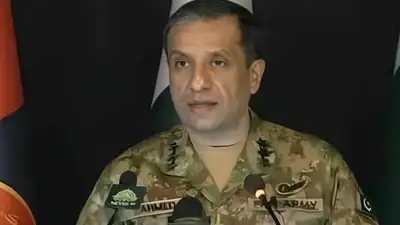
File photo: Pakistan’s military spokesperson Lieutenant General Ahmed Sharif Chaudhry
Pakistan’s ISPR Chief Clarifies Nature of Recent Defense Agreement
Lt Gen Ahmed Sharif Chaudhry, the director general of Pakistan’s inter-services public relations (ISPR), addressed the nature of a recent defense agreement in an interview with Al Arabiya. He characterized the agreement as strictly “defensive” and stated it is intended to complement existing alliances among the involved countries.
Chaudhry emphasized that the agreement does not reflect any aggressive intentions or regional ambitions. “It is defensive. There’s nothing aggressive. There are no regional aspirations. It is collective deterrence,” he asserted.
He noted that while the mutual defense commitment is clearly outlined in the publicly available text, the specific operational details regarding implementation remain classified.
Pakistan’s parliament had unanimously rejected a request in 2015 to send troops to join the Saudi-led coalition against the Houthis. Turkey had previously suggested Egypt could join, although Cairo has not confirmed any such move.
“There is nothing in the pact that says that it is a Muslim alliance,” he said, describing it instead as an arrangement aimed at regional stability. He said other countries could potentially join if they shared the principles of non-aggression, non-interference and collective deterrence, but stressed that any expansion would be a decision for the leaders of Pakistan, Saudi Arabia and Turkey. Pakistan’s foreign office has meanwhile said the immediate priority was to consolidate the new organisation before considering expansion.
The uncertainty is also not entirely new. Pakistan also shares a long border with Iran, giving Islamabad an additional security consideration as it navigates its relationship with Riyadh and Tehran. The comments come amid speculation about possible expansion of the grouping.
“What you’re asking is the how part — how we are going to defend Pakistan against any aggression,” he said, adding that such decisions would be for the three countries to make.