
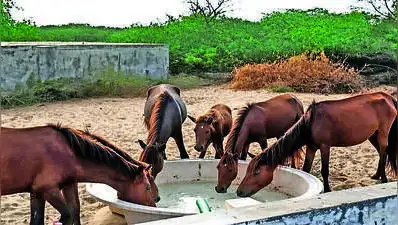
Feral horses at Point Calimere need about 40 litres of water a day
About 20 drinking-water points serve wildlife in and around the sanctuary. These are regularly filled with 15,000 litres of water delivered by tankers. Because of the heat water evaporates fast.
You Can Also Check: Gold Rate in Chennai | Silver Rate in Chennai | Bank Holidays in Chennai | Public Holidays in Chennai | Chennai AQI | Weather in Chennai | Petrol Price in Chennai | Diesel Price in Chennai | CNG Price in Chennai | LPG Price in Chennai Stay updated with the latest Chennai news.
There has been no rainfall in the region since Feb and temperatures are soaring on account of El Nino, says Nagapattinam district forest officer D Rameshwaran. “We are buying thousands of litres of water from various sources, transporting it by tanker and filling troughs for the animals,” says the DFO. “An adult feral horse needs about 40l of water a day,” says a sanctuary staffer. Also, the feral horses deposit large quantities of dung in the troughs,” says A Joseph Daniel, Vedaranyam forest range officer. “We have stepped up patrolling in the villages to keep track of animals that wander outside the sanctuary,” says Rameshwaran. “The sanctuary ranks among the state’s most important bird-arrival sites, but we don’t see many migratory birds now because of the drought ,” says wildlife biologist I Arivu. “Migratory bird numbers will increase once it starts raining,” says Arivu.
Every day, dozens of water tankers roll into Point Calimere Wildlife and Bird Sanctuary in Kodiyakarai, Nagapattinam district, carrying thousands of litres of water for animals. The wetlands within the reserve forest areas — including swamps, mudflats and salt marshes that normally hold water — have dried up. The sanctuary, a Ramsar site and wetland complex covering 21sqkm, supports a variety of herbivores such as blackbucks, chital (spotted deer) and black-naped hares; carnivores including golden jackals, monitor lizards, Indian grey mongooses and jungle cats; omnivores such as bonnet macaques, wild boar and small Indian civets; and frugivores like the short-nosed fruit bat. It is also home to hundreds of feral horses, which are neither native to the sanctuary nor classified as wildlife. “They account for the largest share of water consumption. Some sites also have storage tanks, sumps and bore wells from which water is pumped daily, although the groundwater table has fallen. The department has also placed plastic saucer-type water tanks at various spots and along roadsides. “We are facing some difficulty in maintaining water supply. In dry periods, spotted deer and feral horses enter nearby villages in search of water. There they risk being hit by vehicles or attacked by stray dogs. Muniyappan lake, one of the largest water bodies and a key congregation point for wildlife and birds, has dried up. Download the TOI App.